Showing posts with label Others. Show all posts

Friday, February 24, 2012

Lumus OE-31 Turns You Into a Cyborg

Display technology vendor Lumus showed off its newest optical engine, the OE-31. Taking advantage of the very latest tech., the OE-31 is a compact transparent HUD that you can stick into motorcycle helmets, prescription glasses, sunglasses, fashion eye-wear to even skiing (and we'd imagine diving) glasses. The optical engine is a little more than just a small display, it is backed by a small sensor that sees things from your perspective (in a mechanical sense), and overlays information accordingly (such as a GPS overlay for bike helmets, or finding your way around The Pentagon), in other words, it's an augmented reality engine that's a lot more compact.

The new sensor design allows for a 19-degree field of view and a full-color, 640x360 picture display, which Lumus believes will be sufficient for reading a lot of text, its viewing experience should be comparable to watching a 40-inch screen from 10 feet away.


Source: Engadget

Sunday, February 12, 2012

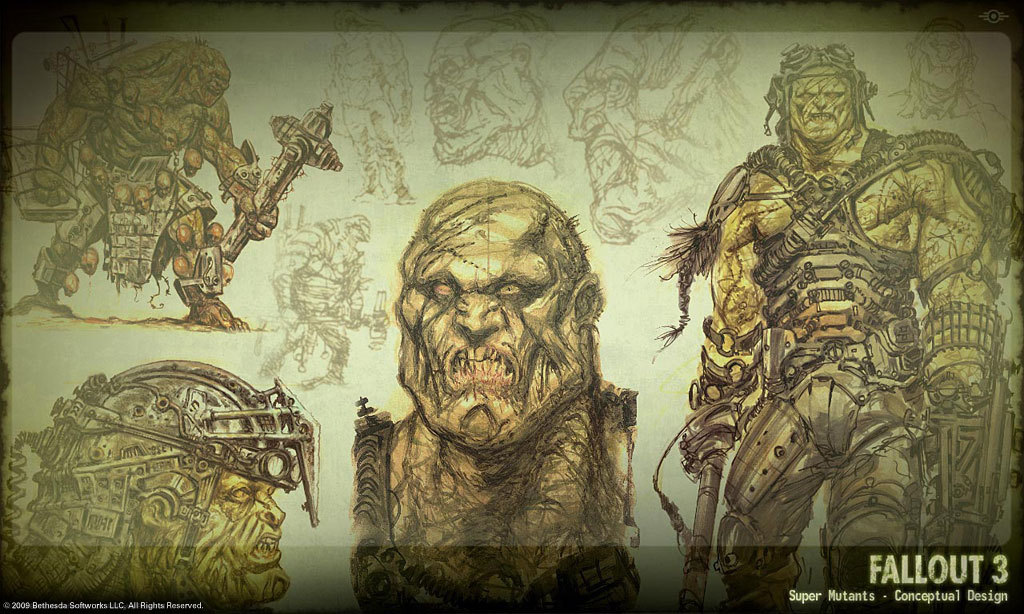
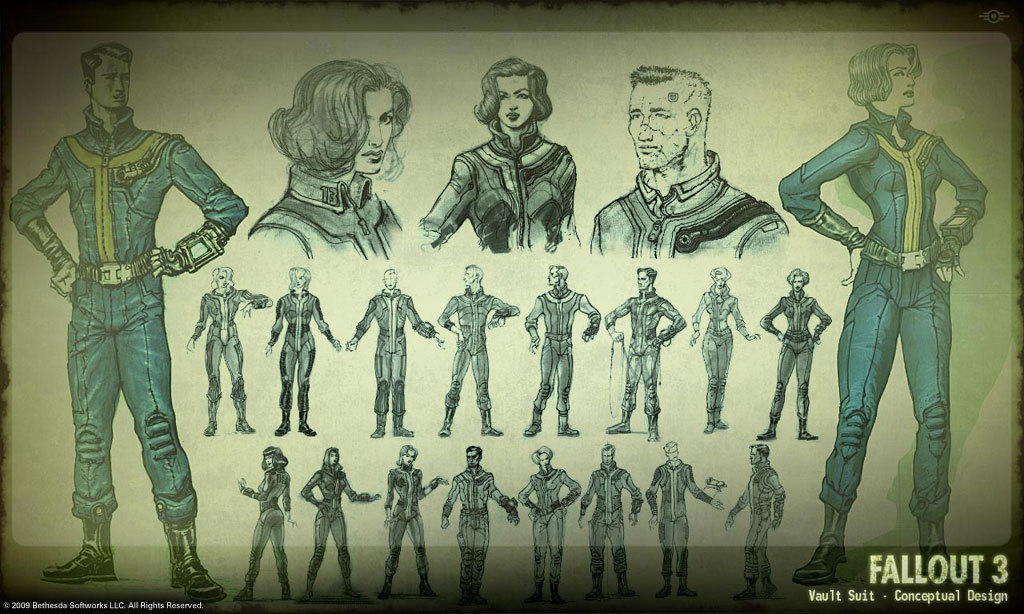
SKYRIM and Fallout 3 Conceptual Artist Adam Adamowicz has Passed

On 10th Feb 2012, the creative mind behind SKYRIM and Fallout 3, Adam Adamowicz fell in his battle with cancer. Mr. Adamowicz was the lead artist behind the entire artistic concept of the two modern day gaming masterpieces Fallout 3 and SKYRIM, giving those worlds life and personality. Everything from coin operated fallout shelters to dragons atop snowy peaks was first visualized and created in the mind of Adam Adamowicz.


In a quote from Vault Diary he stated, "Visualizing all of the aspects of a make believe world is quite an educational experience. On any given day I could be simultaneously learning about multiple topics, from motorcycle engines to 50’s fashion design. It’s kind of like writing and filming a National Geographic documentary film for an actual sci-fi world. For this job, I think the more you read on a wide variety of subjects, the better equipped you are to create depth and realism, especially for a fantasy setting. The fantastic that’s grounded in real world elements and then elaborated and exaggerated upon, seem to work the best, and create a solid jumping off point. This often creates fertile ground for generating additional story elements that can influence costumes, machines, and even motives for the various personalities inhabiting a made up world.

Seeing Syd Mead lecture in SF was an incredibly profound lesson on design. During the Q&A I asked him how far he went on a design to make it technically believable. His advice was ‘to design with the story in mind and stay consistent with it’. Hence I learned that the Sulacco from Aliens is essentially a massive gun in space with a big nuclear reactor at one end which beautifully fits the theme of space marines exploring a planet infested with deadly hostile aliens. That answer freed me obsessing over minutiae that diverges story-wise, and focus on the broad strokes that propel the story. The addition of ensuing consistent minutiae would give it richness."

The industry and the world has truly lost a great visionary and no matter what the next Fallout or Oblivion game will be, it will be a little less wonderful because of it.

Source: Awesome Robo Vault Diary

Thursday, February 9, 2012

Google To Launch GoogleDrive Cloud-Storage Service Soon

Google is going to monetize its ocean of data storage and bandwidth by starting a new service that will rival the likes of DropBox. Called Google Drive, the service could allow people to make use of their G-Mail storage quota (like G-Mail Drive once did) for free, and probably offer additional storage at a cost. According to Wall Street Journal, the service is expected to be launched "soon" (in the next few weeks or months). To compete with other similar service providers, Google could come up with attractive prices. Unlike services such as MegaUpload, Google Drive would be strictly personal storage. The Drive service will be inter-twined with Google Docs, and facilitate better remote collaboration between co-workers.


Sources: The Verge, Wall Street Journal

Wednesday, February 8, 2012

Heat Key To Faster HDDs...Hundreds of Times Faster

Physicists have discovered a new method of recording data on hard drives that could potentially make mechanical hard drives hundreds of times faster (in terms of performance). Heat holds the key. A hard disk drive is a magnetic storage device, which, unlike magnetic tapes, allows random access. Its recording surfaces consist of hundreds of billions of tiny portions that can be magnetized in a particular polar direction to represent 0s or 1s. To create meaningful arrangements of these portions (bytes), the recording heads apply an external magnetic field to flip their polarities.

A team of researchers led by Thomas Ostler at the University of York, UK concluded that the process of flipping the polarities of these tiny portions can be greatly expedited using short bursts of heat. It has been believed that heat could only assist in remagnetization, when used in conjunction with a magnetic field. Research shows that this can also be achieved using a very, very precise amount of heat generated by beaming a fine laser for less than a trillionth of a second, which momentarily raises its temperature by 800 °C. The results of this study was published here.


Researchers say that the new method of magnetic recording can achieve terabytes per second (1000 GB/s) recording/reading speeds. The process also uses less energy than magnetic recording, meaning the new drives would be more energy efficient.

Source: New Scientist, Image Courtesy Gizmodo

Adobe Working on Sandboxed Flash Player for Firefox

Adobe is working on a new sandboxed version of the Flash Player browser plugin for Firefox. The move will make it tougher to compromise a system's security using malicious Shockwave Flash objects. The new plugin for Firefox (and other browsers like Opera, which rely on the common Netscape Plugin Wrapper model of browser plugins), will work essentially similar to the Flash Player Google Chrome ships with, which works in a "Protected Mode". When "sandboxed" Shockwave Flash objects in webpages will work as separate processes, with much lower privileges than the actual user, the user's machine environment will be kept abstract to it. Adobe has already redesigned the browser plugin of its Reader X (PDF viewer) to work this way, and hasn't seen a significant successful exploit since November, last year.


Source: Adobe Asset Blog

Friday, February 3, 2012

AMD Outlines Its 2012-2013 Client Roadmap, Big Focus is on APUs

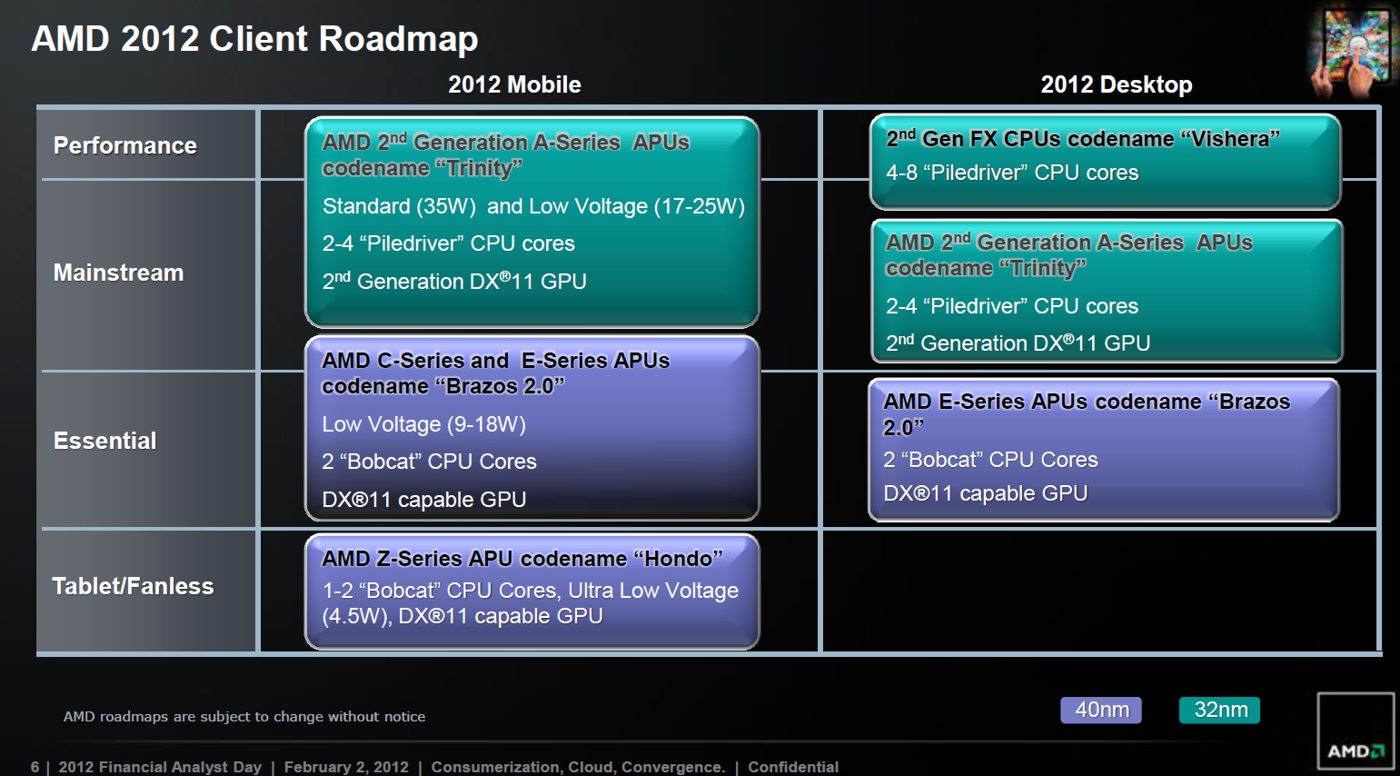
At its annual Financial Analyst Day, AMD has presented an updated roadmap detailing the hardware it plans to bring to the table during 2012 and 2013. For this year, the Sunnyvale-based company is preparing a processor quarter which includes the Trinity, Brazos 2.0 and Hondo APUs (accelerated processing units) and the Vishera CPU.

Set to be the main weapon in AMD's x86 arsenal, the Trinity APU (aka the 2nd gen A Series) is made on 32 nm process technology, and features DirectX 11 graphics, two/four Piledriver cores (Piledrive is said to deliver 25% better performance than the Stars cores found in Llano APUs), and a TDP that can go as low as 17 W on mobile parts. Trinity is expected to debut in Q2 and already has close to 100 design wins (more than Llano had before its release).


The Brazos 2.0 (C and E Series) and Hondo (Z Series) APUs are 40 nm parts and feature up to two Bobcat cores, DirectX 11 graphics, and a TDP going from 4.5 W to 18 W. These are designed for low-power/low-cost mobile and desktop devices.

On the CPU front 2012 will see to the arrival of the 32 nm Vishera parts (2nd gen FX Series) which will feature 4, 6 or 8 Piledriver cores. Interestingly-enough, Vishera is listed as the sole CPU for 2013 desktops too so it seems AMD won't be doing much in this segment, apart from maybe releasing higher-clocked models.

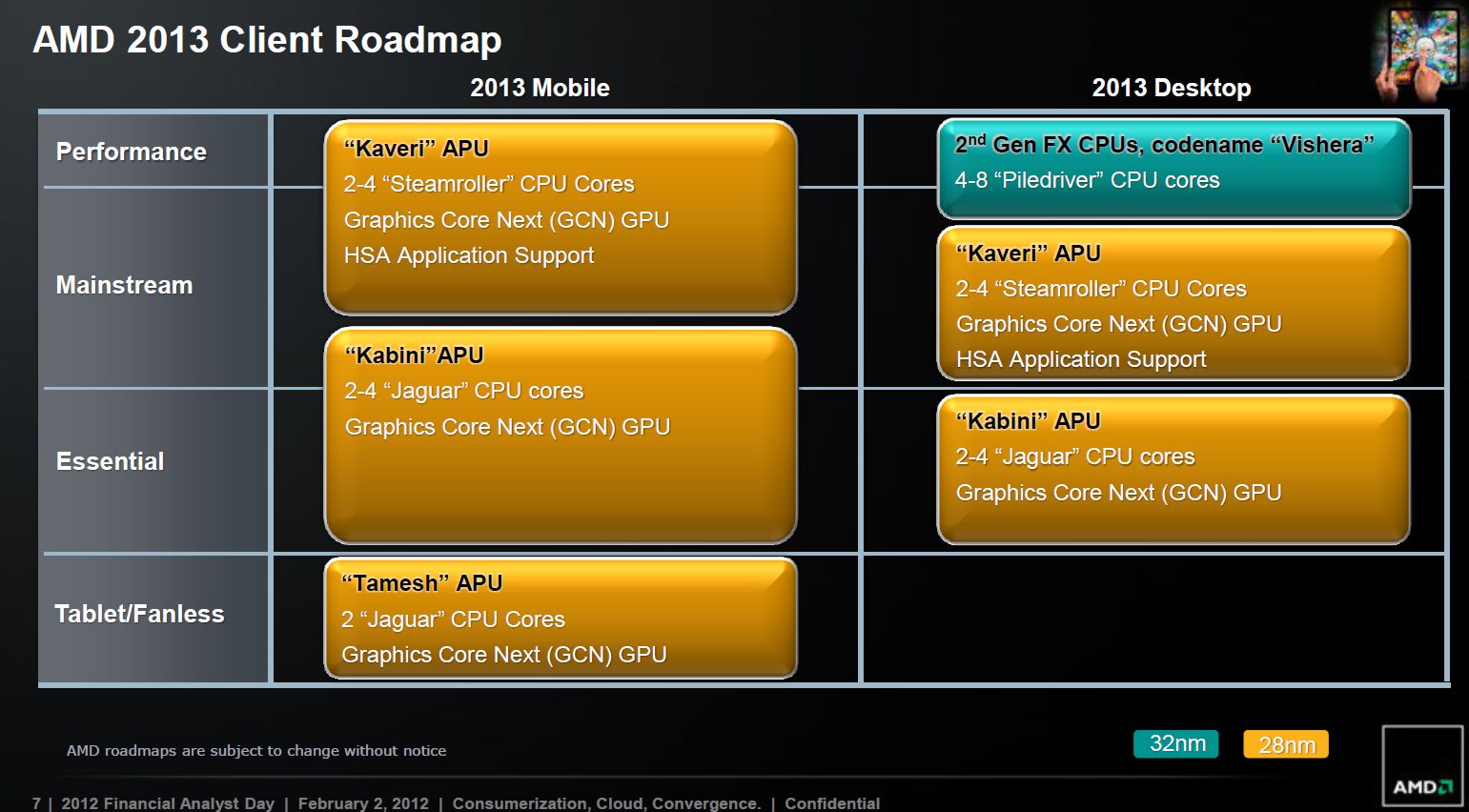
For 2013 AMD is readying a LOT of 28 nm chips, including the Sea Islands GPUs - said to have a 'new architecture' and HSA (Heterogeneous Systems Architecture) features, and the Kaveri, Kabini and Temash APUs.

Kaveri is Trinity's successor and it will feature a DirectX 11.1-supporting (GCN-based) GPU, 2 to 4 Steamroller x86 cores, and HSA application support. Kaveri will cover the mainstream mobile and desktop segment so Kabini and Temash will focus on lower-cost/lower-power hardware.

Both Kabini and Tamesh will have GCN graphics and will make use of Jaguar x86 cores. Kabini will have up to four x86 cores while Tamesh will feature two. No ARM in sight here, maybe we'll have to wait a bit more.

Source: PC Perspective

Facebook Files $5 Billion IPO, Values it at Nearly $100 Billion

Facebook Inc., has finally filed to go public with its IPO, with plans to raise US $5 billion, according to a figure used to calculate the registration fee. The company seeks to trade under the ticker symbol "FB", although it did not list an exchange. It is speculated by those close to the company that Facebook is aiming at a far greater offering that will value to the company close to $100 billion. Facebook also provided some interesting stats about its operations in its filing. The EDGAR filing documents can be accessed here.


Source: Engadget

Tuesday, January 17, 2012

AMD Announces the First AMD Fusion Center of Innovation

AMD today announced the first AMD Fusion Center of Innovation at the University of Illinois at Urbana-Champaign, designed to focus on the innovative developer environment and software performance advancements enabled by heterogeneous computing. The center will fund, mentor and promote new commercial enterprises emerging from the vast intellectual property and research expertise in the University of Illinois community.

The University has been a hotbed of new start-ups since the creation of the first widespread web browser - Mosaic - developed by Marc Andreessen in 1992. Through access to AMD Accelerated Processing Unit (APU) technology and platforms, the AMD Fusion Center of Innovation will help bridge access to new AMD heterogeneous computing technology with the innovative spirit stimulated and nurtured on campus.


To kick-off the AMD Fusion Center of Innovation, the University of Illinois at Urbana-Champaign is offering a course aimed at kindling the spirit of entrepreneurship by bringing a mix of expert speakers to cover the specifics of AMD heterogeneous computing technology, while also providing invaluable, how-to background on entrepreneurship, commercialization and start-up creation. This course will be offered by the university's College of Engineering, Technology Entrepreneur Center (TEC), as "ENG/TE 360/460: Lectures in Engineering Entrepreneurship AMD Section."

At the completion of the course, students will submit projects which will be evaluated for potential funding opportunities through the AMD Fusion Fund and IllinoisVENTURES. Computer science and engineering students are encouraged to share their best ideas for new software or web-based start-up companies.

"Through their involvement with the Technology Entrepreneur Center, companies like AMD are helping to further develop the Illinois entrepreneurship ecosystem here in the Midwest," said Andrew Singer, Professor, Department of Electrical and Computer Engineering, and Director, Technology Entrepreneur Center, at the University of Illinois at Urbana-Champaign. "Offering the latest innovative computing hardware and software technologies and bringing them into the classroom, where students can apply their ideas and form new ventures will be a great advantage for the generation of new innovative ideas that can be commercialized through the AMD Fusion Center of Innovation."

Rob Schultz, senior director of IllinoisVENTURES and a partner of the Illinois Emerging Technologies Fund said, "We are encouraging the university community to think big about what's possible through software and web services by focusing on the creative aspects. The AMD Fusion Center of Innovation will provide a spark for new software and web ideas as students receive hands-on access to AMD APU technology and learn how to enable richer user experiences using heterogeneous computing."

AMD APU technology combines a multi-core CPU and discrete-level GPU and other hardware accelerators on a single power-efficient chip enabling user interface innovation, vivid HD entertainment and content creation, blazing fast Internet browsing and accelerated media applications. Consumers can enjoy rich, smooth performance, skip-free HD playback and discover impressive speed and performance in everyday applications on their PC when using AMD APU technology.

"The AMD Fusion Center of Innovation at the University of Illinois at Urbana-Champaign provides the perfect environment of academia and software development," said Manju Hegde, corporate vice president, AMD Fusion Experience Program. "We believe heterogeneous computing will be the enabler for innovative user interfaces and immersive computing experiences, which will ultimately be driven by aspiring and audacious students. The University of Illinois at Urbana-Champaign will serve as a model for future AMD Fusion Centers of Innovation around the world."

Source

Tuesday, January 3, 2012

Dishonest Intel OEM Engineers To Get Five Years Behind Bars

The Taiwan Criminal Investigation Bureau has been doing a bit of investigating and has arrested four engineers working for Intel's OEM partners (names not disclosed) for flogging Engineering Sample (ES) processors on eBay. ES processors are intended strictly for qualification testing purposes for development of new products by OEM's and are only loaned to them under strict non-disclosure agreements, hence putting these on eBay is illegal. The Bureau searched the suspects houses last month and found 178 ES CPU's, worth around $800,000. Note that this value seems to be somewhat high, as it would make each CPU worth around $4,500. We will update this article if new values come to light. Also, this is not a new operation that has been busted, since the suspects had admitted to selling around 500 ES CPU's since 2009. For their efforts, the fab four now face five years in prison.

It should be noted for anyone contemplating the purchase of such dodgy CPU's on eBay or similar places, that they may be overstressed and contain faults, due to the intensive and sometimes destructive testing they go through. Just don't do it, kids.

Source: TechEYE

Wikipedia Reaches $20 Million Fundraising Goal

It looks like those large "personal appeal" banners from Wikipedia's founders, staff, and contributors seemed to have finally "paid off", with the foundation achieving its US $20 million fundraising goal. Wikipedia is an ad-free service, but relies on donations to operate. While you can donate to Wikipedia any time of the year, the foundation starts fundraisers each time it's faced with a cash-crunch.

Sue Gardner, Executive Director of the Wikimedia Foundation thanked all donors "We've taken down our fundraising banners, because we’ve hit our target. Thanks to you. Over the past few months, more than one million people have come together from all over the world to keep Wikipedia and its sister sites alive and flourishing for another year." She continued: "Your support is how we pay our bills. People like you, giving five dollars, twenty dollars, a hundred dollars. Thank you for helping us. We’re the #5 most-popular site in the world --- we operate on a tiny fraction of the resources of any other top site. We will use your money carefully and well, I promise you." So there you go, no more opening articles about, say, massacres or wars to find inappropriately-placed pictures of smiling contributors or Wikipedia staff asking you to drop a few quids.


Source: Wikimedia Foundation

Friday, December 30, 2011

Japanese to Launch WiFi Vending Machine; Creative Marketing

It is a very creative way to market their vending machines.

It’s no secret that Japan is the country of vending machines (they even have models like this one now), but this is new: Tokyo-based beverage company Asahi Soft Drinks took the wraps off a vending machine [JP] that not only offers drinks but also sends out WiFi signals within a 50m radius.

The WiFi will be available for free, is accessible with multiple devices, without registration, and for anyone to use (meaning users won’t have to buy any drinks to go online through the machine). It’s possible to use the web for about 30 minutes before the machine cuts you off (re-connecting is possible, however).
After logging in, users will see various location-specific information on the home screen, for example on local stores, or sightseeing spots.

 Starting in 2012, Asahi will set up 1,000 of the vending machines in five different regions in Japan (Tokyo, Sendai, Chubu, Kinki, and Fukuoka) in the first year. The plan is to roll out a total of 10,000 units in the next five years. Asahi is currently operating 250,000 vending machines all over Japan.

Sunday, December 25, 2011

U.S. Army Attacks the CryEngine

The U.S. Army might be financing one of the most epic videos games ever made that very few people may ever play. The "game" is called Dismounted Soldier Training System and was commissioned by the U.S. government back in May for a staggering cost of 57 million dollars. The contract was awarded to RealTime Immersive Inc. All of this according to PC Gamer. Everything about this simulator is said to be cutting edge but the hardware it runs on. In a GamePro interview with the director of strategic programs at Intelligent Decisions, Floyd West is said to have stated, "With CryEngine 3 being used for Crysis 2 and the capabilities that game engine provides, it allows us to make the most realistic simulation possible. We’re able to transport soldiers to accurately recreated locales like Afghanistan and Iraq, where we can simulate everything from visuals to 360-degree sound."

The virtual reality headsets the trainees wear will run from a backpack unit similar to a top of the range gaming laptop, called the 'Man Wearable Unit'. "While the man wearable units aren’t running on an off-the-shelf Alienware, the internal components themselves are commercial off-the-shelf CPUs and GPUs like NVIDIA graphic cards and whatnot."

As this is an internal military training simulator we the public may never play it. However that doesn't mean we cannot watch the trailers in awe and wonder if our own rigs could render thousands of kilometers in such massive detail.

Trailer 1 | Trailer 2


Source: PC Gamer

Friday, December 16, 2011

Nomura Equity Research Thinks More Factors Than HDD Shortage Behind Intel's Reduced Q4 Revenue Forecast

Nomura Equity Research, an investment broker, recons that factors other than, and more significant than hard disk drive (HDD) shortage caused due to the recent Thailand floods affecting HDD manufacturing, are behind Intel's reduced Q4 forecast. Earlier this week, Intel shaved off close to a billion dollars from its Q4 Revenue Guidance, leveling the blame on HDD shortages, as HDD is a near-indispensable component in manufacture and assembly of a vast majority of PCs. Nomura Equity Research thinks "weak sell-through" is that other factor.

Nomura Equity Research said "HDD shortages are a concern, but we think weak sell-through is also contributing to the $1 billion shortfall." It continues, "We see softness in China, continued demand for ARM-based more power-efficient devices, and low volumes for ultrabooks." Intel is clearly feeling the heat with depleting demand for Wintels, as entire PC form-factors are challenged by leaner, fitter computing devices such as tablets, netbooks, and smartphones driven by ARM processors are growing in demand.

Nomura adds "We would not be surprised to see below-seasonal growth in Q1 and Q2 given lack of PC catalysts (Windows 8 likely Q3 event), increasing ASP pressure, and slowing China and Europe." It concludes its report by cutting its forecast for Intel sales revenue in 2012 by $3 billion to $53.4 billion, a fall from its estimate for Intel's 2011 sales revenue of $53.8 billion.

Source: EETimes

Monday, December 12, 2011

Hard Disk Drive (HDD) Shortage To Go On And On And On

The recent Thailand floods appear to be taking a bigger toll than expected, with the effects of the shortages to be felt all the way into 2013, according to market research firm IDC. This isn't helped by the fact that the largest manufacturer of HDDs, Western Digital, was hit the hardest. As the situation is so volatile, companies such as HP, Dell & Lenovo are keeping watch on the market daily and are even sometimes having to accept drives of a lower spec if they are to ship some systems at all. As expected, the retail purchaser of hard disk drives comes bottom of the allocation list. IDCs John Rydning said in a statement: "I think the most painful period will occur now through February of next year. We expect the situation will improve, but it won't feel as if things are back to normal until 2013". There's more detail and analysis over at Network World.

Source
Friday, December 9, 2011

Hackers Can Make HP Printers Catch Fire!! Well, Singe Paper

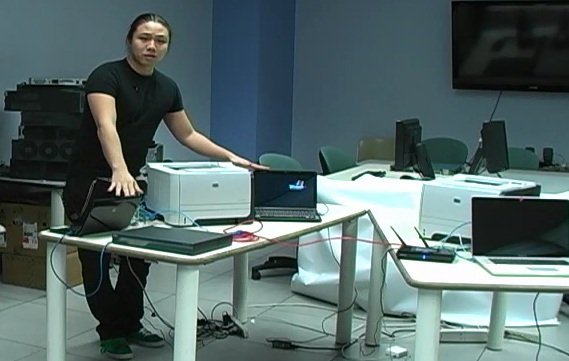
Researchers at Columbia University have investigated the security of HP network printers and have found them wanting. The basic problem is the complexity of the devices and the fact that the authenticity of firmware updates for these devices isn't checked by using a digital signature. MSNBC published an exclusive story, explaining how by using a hacked computer, the researchers could make their test printers do various nasties, such as continuously heat the fuser unit until the paper singed, at which point the printer shut off due to the built-in safety device, a thermal switch which cannot be overridden by software. They could also be programmed to spread viruses, which would be very dangerous, as these attacking printers would be within the firewall perimeter, allowing them unrestricted access to the soft underbelly of the network. And as the MSNBC article put it so well: "Few companies are prepared to protect themselves from an attack by their own printer." Quite, seems ridiculous at first sight, doesn't it? The researches focused on HP printers, which are by far the most popular brand out there, but say that there are similar vulnerabilities within all devices which employ embedded networked computers, leaving them wide open to attack, hence the industry should wake up to this threat and fix their systems before hackers start to exploit these for real. HP for their part, played down the overall threat and disagreed on several points made by the researchers. Also, the attacks were carried out using Linux and MAC computers and the suggestion seems to be that it's somehow harder to do with a Windows computer. There's a lot more detail at the MSNBC article and readers are encouraged to check it out.


Thursday, December 8, 2011

Windows 8 'Irrelevant' For PC Users

Well, it looks like the Windows 8 flagship feature, the Metro interface, isn't going down too well with PC users, according to leading market research firm International Data Corp. On top of that, there aren't really any killer improvements in the operating system that make shelling out for a new version compelling. The Metro interface, while suited to a smartphone or tablet, really doesn't do anything for a desktop PC, because it's operation is very restrictive compared to the standard desktop that's been around for over 15 years on Windows and is now a very refined and sophisticated user interface. Also, the fact that many organizations have only recently migrated to Windows 7 and are not looking to spend money in the current economic climate and go through the pains of another upgrade cycle again isn't helping. The poor economy looks like it will hamper sales of Windows 8 on its target devices, tablets, too. Finally, IDC said: "(T)here will be intense scrutiny on Microsoft’s ability to deliver a successful tablet experience aboard both x86-based tablets and on devices running ARM processors. This is a tall order for Microsoft, and while the x86 tablet strategy makes sense as a transitional solution for today’s PC users, it will be the ARM-based devices that need to shine and clear a high bar already set by Apple."


Sources: xbit labs, zdnet

Senseg Develops New Revolutionary Haptic Touchscreen

Touchscreen display developer Senseg revealed prototypes of its haptic touchscreen displays. Simply put, these are displays that can reproduce the texture and "feel" of surfaces, apart from reproducing moving images. For example, it can reproduce the texture and feel of silk and rock. Senseg is calling its display "Feel Screen". The Feel Screen is already backed by a 4D display technology, in which images consist of "tixels" (pixel with touch-texture information). We've all probably been to 4D movies, in which apart from 3D visuals, a fourth dimension (usually physical effects). Think of compact haptic displays as being similar, only here the fourth dimension is touch texture.

How does it work? Feel Screen, like every touchscreen, could be a layered display at its lowermost layer is the LCD that displays visuals (capable of even stereo 3D), above that is a touchscreen layer, and above that, a haptic layer that generates mild electrostatic fields. Touch-textures are created by making and manipulating an attractive force between the finger and that electrostatic field. The screen can reproduce surface textures and create the sensation of vibrations. Sounds too Sci-Fi? Well, Senseg stated that it will be able to mass produce displays based on this technology in 2012, which will then market by 2013. Senseg owns all patents related to this unique technology. Some of the most valuable ones could be related to how Senseg went about designing its electrostatic haptic layer to prevent it from interfering with the capacitive touchscreen layer. Please don't evaporate.


Sources: TechWatch.co.uk, VR-Zone

IBM's Racetrack Memory, Data Storage At Superfast DRAM Speeds

Racetrack memory, is a new type of magnetic memory that has magnetic domain "racing" along tiny nanometer sized wires, giving performance similar to conventional DRAM. Invented by IBM Fellow, Stuart Parkin, it has been in development since about 2004, with a working prototype having now been unveiled containing 256 "racetrack" cells, each containing a single wire. The technology works by sending very fast electric pulses down these wires, measured in nanoseconds, which transmit very fast moving magnetic domains which are then read by a magnetic head either as a one or a zero, depending on their direction. IBM said in a statement: "This breakthrough could lead to a new type of data-centric computing that allows massive amounts of stored information to be accessed in less than a billionth of a second."


IBM has an article on this technology and in it, they give a very clear and detailed explanation of how this technology works, so we'll let them explain:
IBM Researcher Stuart Parkin pioneered the development at the company’s Almaden Research Center in San Jose, California, starting in about 2004. Parkin conceived of a device consisting of a city of skyscrapers—each one only hundreds of atoms wide—of magnetic material, with each floor of each skyscraper containing a single bit of data. The data is shot up and down the skyscrapers—almost like a supersonic elevator—by using special currents of electrons for which the spins of the electrons, a quantum mechanical property, are aligned in the same direction. By passing such “spin polarized” currents through the data, the magnetic data can be moved up and down the skyscrapers which are vertical racetracks. These currents are generated by a transistor connected to the bottom of each skyscraper. “In this way, each transistor can store not just one bit of data, as in all other solid state memory, but rather 100 bits,” Parkin said. “This means that one can have a solid state memory with the same low cost of a disk drive but with a performance 10 million times better!”

A personal storage device using racetrack memory could fit into a lapel pin and record every conversation its wearer has for years before filling up. In enterprises, massive storage could be dispersed, with terabytes of information built into every device, sensor, camera and doorknob.
Makes today's expensive "cutting edge", low capacity, limited lifetime and above all, way slower Flash-based SSD's seem so yesterday, doesn't it? One can imagine Windows booting up near-instantaneously with one of these.

Sources: BBC, IBM

Intel and Micron develop first-ever 128 Gb NAND Flash memory chip

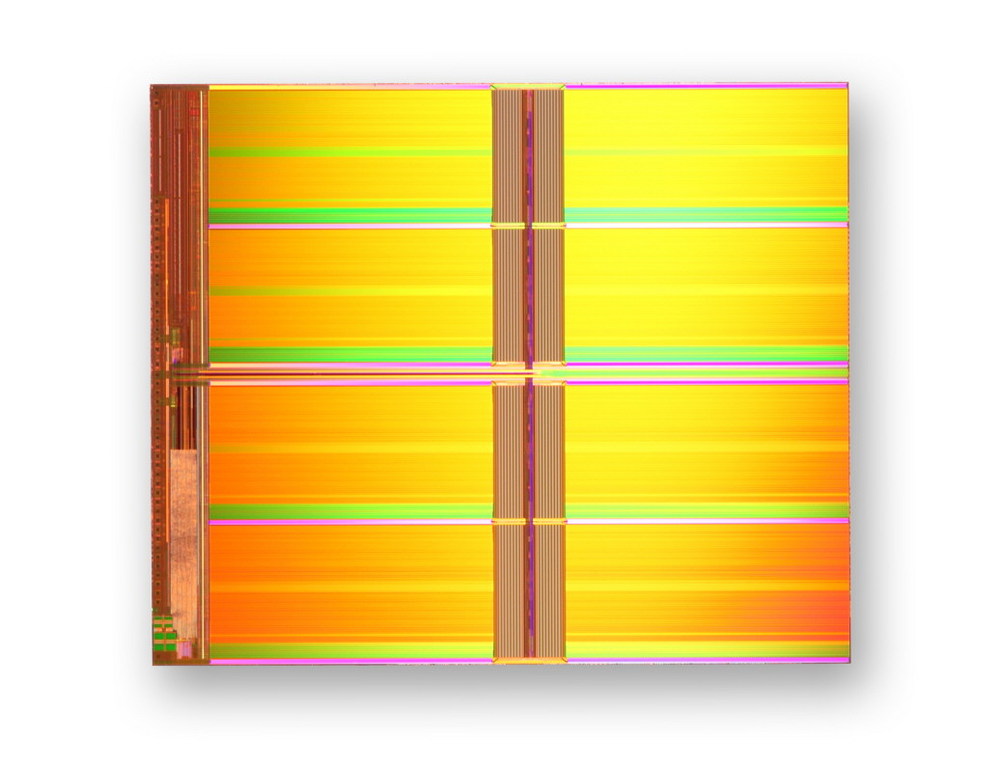
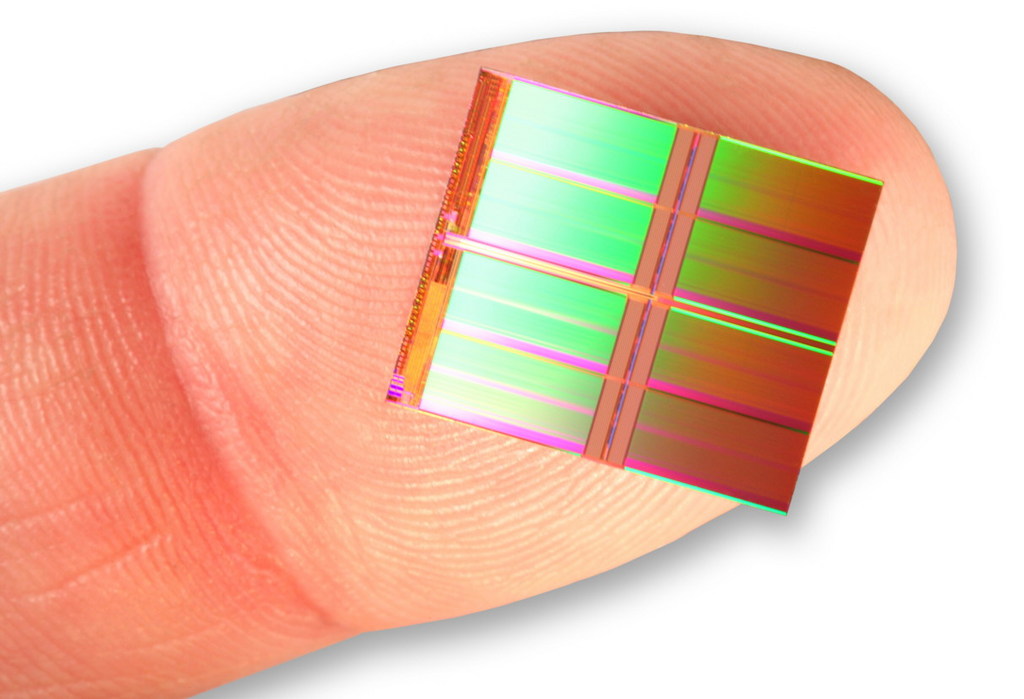
Flash buddies Intel and Micron have today announced a significant breakthrough in terms of NAND density, the first 128 Gb (16 GB) MLC NAND memory chip. Manufactured on 20 nm process technology, this 128 Gb chip complies with the ONFI 3.0 specification (enabling speeds of up to 333 megatransfers per second) and can be used for new, high-capacity solid state drives, as well as for next-generation tablets, smartphones and other portable devices.

According to Intel and Micron, this milestone was made possible by the use of a new, innovative cell structure that 'breaks the scaling constraints of the standard NAND floating gate cell by integrating the first Hi-K/metal gate stack on NAND production.'


"It is gratifying to see the continued NAND leadership from the Intel-Micron joint development with yet more firsts as our manufacturing teams deliver these high-density, low-cost, compute-quality 20 nm NAND devices," said Rob Crooke, Intel vice president and general manager of Intel's Non-Volatile Memory Solutions Group. "Through the utilization of planar cell structure and Hi-K/Metal gate stack, IMFT continues to advance the technological capabilities of our NAND flash memory solutions to enable exciting new products, services and form factors."

IM Flash Technologies (the NAND joint venture of Intel and Micron) will have samples of the 128 Gb MLC chip in January and expects to start mass production in the first half of next year. In the mean time, the JV has ramped up mass production of its 64 Gb 20 nm NAND memory.

Source

Saturday, December 3, 2011

IBM to Produce Micron's HMC in Debut of First Commercial, 3D Chip-Making Capability

IBM (NYSE: IBM) and Micron Technology Inc. announced today that Micron will begin production of a new memory device built using the first commercial CMOS manufacturing technology to employ through-silicon vias (TSVs). IBM's advanced TSV chip-making process enables Micron's Hybrid Memory Cube (HMC) to achieve speeds 15 times faster than today's technology.

Micron's Hybrid Memory Cube features a stack of individual chips connected by vertical pipelines or “vias,” shown above. IBM’s new 3-D manufacturing technology, used to connect the 3D micro structure, will be the foundation for commercial production of the new memory cube.

IBM will present the details of its TSV manufacturing breakthrough at the IEEE International Electron Devices Meeting on December 5 in Washington, DC.


HMC parts will be manufactured at IBM's advanced semiconductor fab in East Fishkill, N.Y., using the company's 32nm, high-K metal gate process technology.

HMC technology uses advanced TSVs — vertical conduits that electrically connect a stack of individual chips — to combine high-performance logic with Micron's state-of-the-art DRAM. HMC delivers bandwidth and efficiencies a leap beyond current device capabilities. HMC prototypes, for example, clock in with bandwidth of 128 gigabytes per second (GB/s). By comparison, current state-of-the-art devices deliver 12.8 GB/s. HMC also requires 70 percent less energy to transfer data while offering a small form factor — just 10 percent of the footprint of conventional memory.

HMC will enable a new generation of performance in applications ranging from large-scale networking and high-performance computing, to industrial automation and, eventually, consumer products.

"This is a milestone in the industry move to 3D semiconductor manufacturing," said Subu Iyer, IBM Fellow. "The manufacturing process we are rolling out will have applications beyond memory, enabling other industry segments as well. In the next few years, 3D chip technology will make its way into consumer products, and we can expect to see drastic improvements in battery life and functionality of devices."

"HMC is a game changer, finally giving architects a flexible memory solution that scales bandwidth while addressing power efficiency," said Robert Feurle, Vice President of DRAM Marketing for Micron. "Through collaboration with IBM, Micron will provide the industry's most capable memory offering."

Additional information, technical specifications, tools and support for adopting HMC technology can be found at micron.com.

Source IBM to Produce Micron's HMC in Debut of First Commercial, 3D Chip-Making Capability