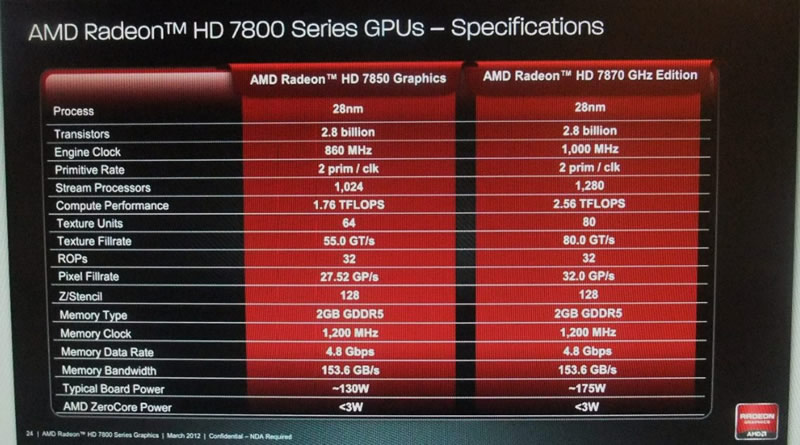
Japanese media has got a hold of the specifications table of AMD's
Radeon HD 7800 series products, the HD 7870 and HD 7850. Hermitage
Akihabara has not cited a source as such, so we assume it vouches for
the accuracy of this table. The table reveals Radeon HD 7870 as having
1280 stream processors, a 256-bit wide memory bus width (derived from
the memory bandwidth and clock speeds figures provided in the table), 80
TMUs, 32 ROPs, and clock speeds of 1.00 GHz core, with 1200 MHz (4.80
GHz effective) memory. This SKU has a typical board power of 175W.
The slide details the HD 7850 as having 1024 stream processors, 64 TMUs,
32 ROPs, the same 256-bit GDDR5 memory interface, with the same memory
clock speed as the HD 7870, but with a lower core clock speed of 860
MHz. the board power for the HD 7850 is mentioned to be under 130W.
Interestingly, 2 GB is standard memory amount for both cards. The
Japanese site mentions the official launch date of HD 7800 series as
being March 8, but also goes on to add that market availability (we're
assuming they mean the Japanese market), is only expected on/after March
19.
Sources: Hermitage Akihabara, VR-Zone, and 456,000+ search results for "AMD Radeon HD 7800 Specifications" on Google
Showing posts with label AMD. Show all posts
Sunday, March 4, 2012
Wednesday, February 15, 2012
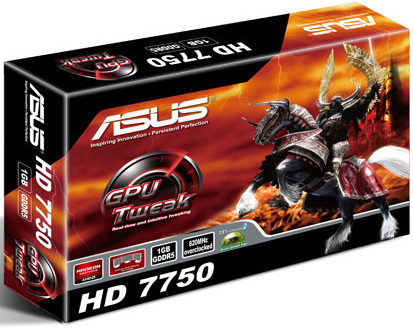
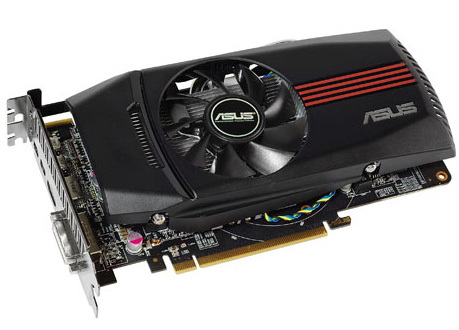
ASUS Launches HD 7770 DirectCu and Non-Reference HD 7750
ASUS launched its Radeon HD 7700 series with two cards, both
non-reference design, which take advantage of proven cooler designs ASUS
used in previously-launched models. The Radeon HD 7770 card is based on
its DirectCU cooler that has been used on a number of upper-mid range
graphics cards. Its cooler consists of a heat-pipe fed aluminum fin
array, in which the heat-pipes make direct contact with the GPU die.
This card bears slightly overclocked speeds, with the core clocked at
1020 MHz (vs. 1000 MHz reference), and 1150 MHz / 4.60 GHz memory (vs.
1125 / 4.50 GHz reference) memory.
The Radeon HD 7750 card from ASUS uses a non-reference PCB and a cooler design which has been implemented on several mid-range graphics cards by the company in the past it is a fan-heatsink with spirally-projecting aluminum fins, with a copper core at the center. The heatsink is ventilated by a large fan, which is known to be very quiet. Like its bigger brother, this card too features slightly overclocked speeds, with the core clocked at 820 MHz (vs. 800 MHz reference), and 1150 MHz / 4.60 GHz memory (vs. 1125 / 4.50 GHz reference) memory. Expect these cards to stick to common prices of US $159 for the HD 7770 and $109 for the HD 7750.
Source
The Radeon HD 7750 card from ASUS uses a non-reference PCB and a cooler design which has been implemented on several mid-range graphics cards by the company in the past it is a fan-heatsink with spirally-projecting aluminum fins, with a copper core at the center. The heatsink is ventilated by a large fan, which is known to be very quiet. Like its bigger brother, this card too features slightly overclocked speeds, with the core clocked at 820 MHz (vs. 800 MHz reference), and 1150 MHz / 4.60 GHz memory (vs. 1125 / 4.50 GHz reference) memory. Expect these cards to stick to common prices of US $159 for the HD 7770 and $109 for the HD 7750.
Source
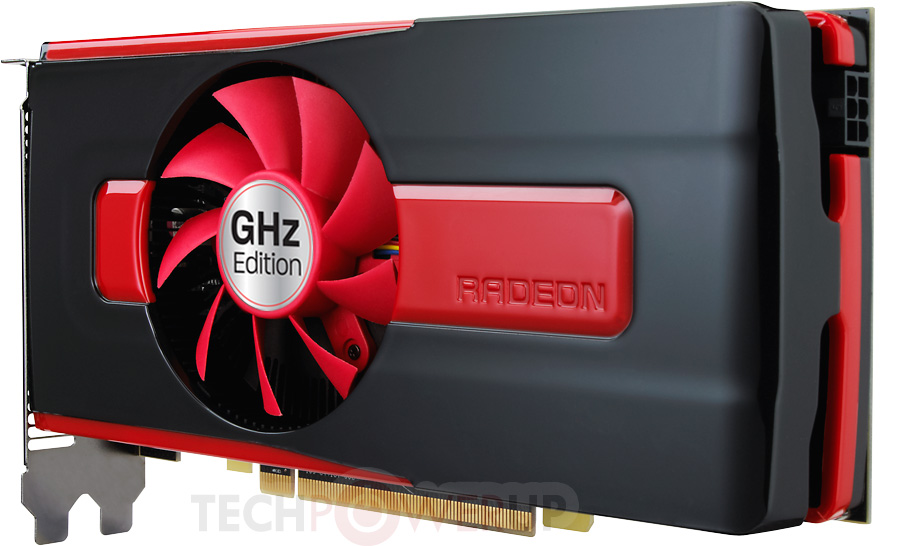
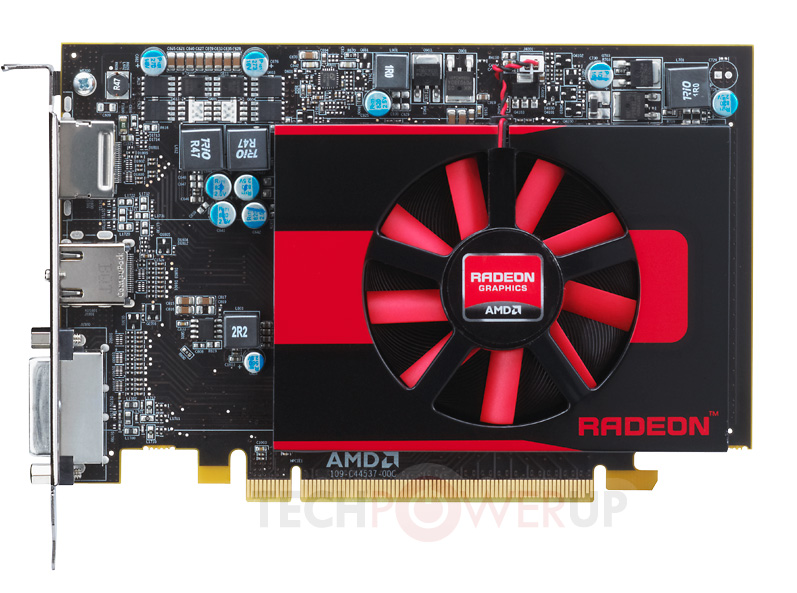
AMD Launches the Radeon HD 7700 Series
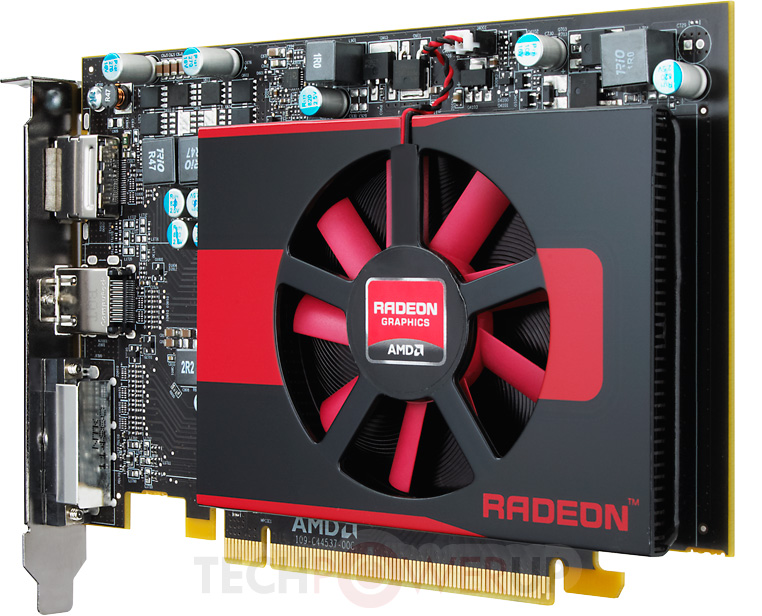
AMD has just launched the new Radeon HD 7700 series, in a bid to cement
its competitiveness in the sub-$200 market-segment. The Radeon HD 7700
series, according to AMD, is designed to offer "the world's most
advanced graphics for everyone." The series is based around a new ASIC
built on the 28 nm fab process, codenamed "Cape Verde". The new chip
takes advantage of the Graphics CoreNext architecture, and features 10
GCN compute units, amounting to 640 stream processors; 40 TMUs, and 16
ROPs; and a 128-bit wide GDDR5 memory interface.
The Radeon HD 7770 has all components on the chip enabled, and features clock speeds of 1000 MHz core, and 1125 MHz (4.50 GHz GDDR5 effective) memory, yielding 72 GB/s memory bandwidth. This card draws power from a 6-pin PCIe power connecor. The Radeon HD 7750, on the other hand, features 512 stream processors, and 32 TMUs. The rest of the specifications are identical to the HD 7770, except core clock speed: 800 MHz. The Radeon HD 7770 is priced at US $159, while the HD 7750 is available as low as $109.
Source
The Radeon HD 7770 has all components on the chip enabled, and features clock speeds of 1000 MHz core, and 1125 MHz (4.50 GHz GDDR5 effective) memory, yielding 72 GB/s memory bandwidth. This card draws power from a 6-pin PCIe power connecor. The Radeon HD 7750, on the other hand, features 512 stream processors, and 32 TMUs. The rest of the specifications are identical to the HD 7770, except core clock speed: 800 MHz. The Radeon HD 7770 is priced at US $159, while the HD 7750 is available as low as $109.
Source
Tuesday, February 14, 2012
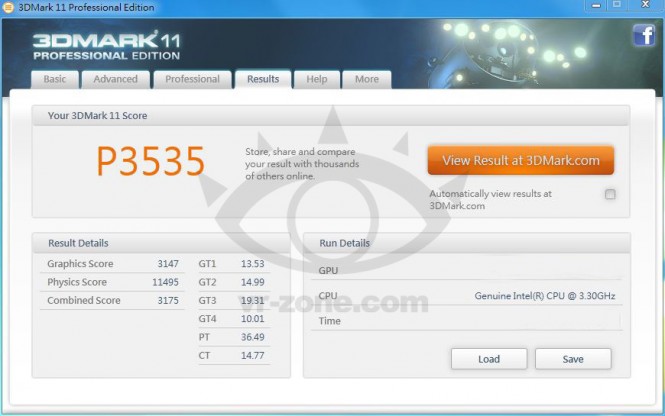
Radeon HD 7770 Put Through 3DMark 11
AMD's Radeon HD 7770 mid-range graphics card, which is slated for a
little later this month, got its first public shot at 3DMark 11. The
card was put through the Performance preset of the benchmark, where it
scored P3535 points. The bench was probably driven by an Intel Core
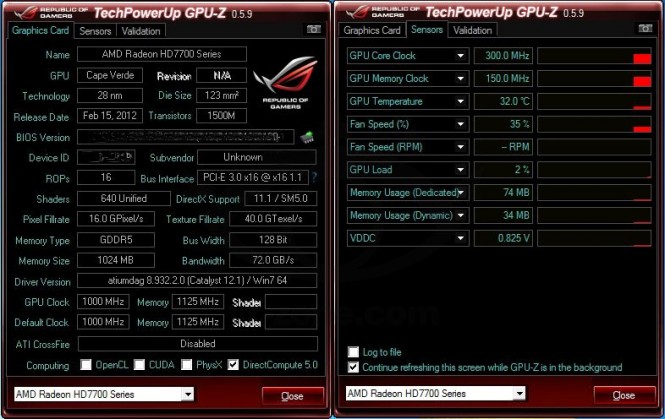
i5-2500 processor. The reviewer also took GPU-Z screenshots of this
card, revealing low core temperature. Based on the 28 nm Cape Verde GPU,
the HD 7700 is said to have 640 Graphics CoreNext stream processors,
and 1 GB of memory over a 128-bit wide GDDR5 memory interface. It is
designed for sub-$200 price points.
Source: VR-Zone
Source: VR-Zone
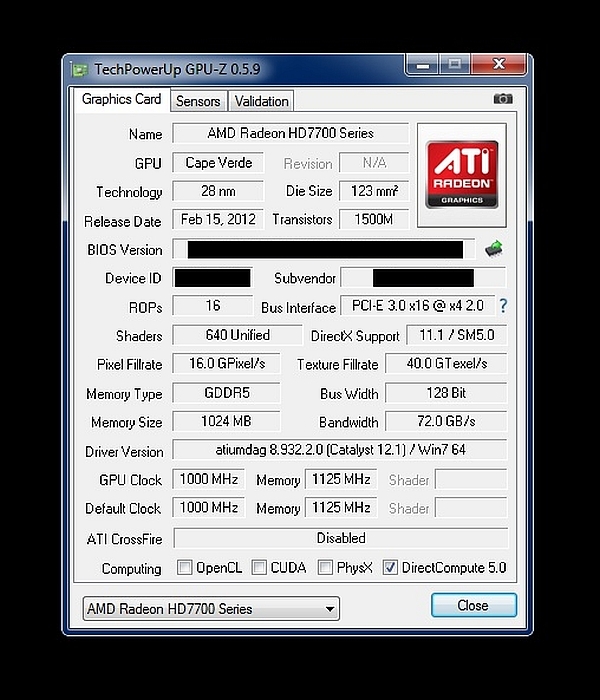
Radeon HD 7770 Specifications Confirmed in GPU-Z Screenshot
Much like a previous exposé with Radeon HD 7950, the specifications of Radeon HD 7770 that were rumored in our previous article
have been confirmed by users. It confirms several specifications,
starting from the stream processor count of 640, to the 128-bit wide
GDDR5 memory interface. The GPU has an out of the box core clock speed
of 1.00 GHz, it could be possible that this is a factory-overclocked
card, if not, the core clock speed rumor sparked off by the Verdetrol marketing campaign are true, after all.
Source: DonanimHaber
AMD "Trinity" APU Models Further Detailed
In the second quarter of this year, AMD will launch its next-generation
accelerated processing unit, codenamed "Trinity", starting with
quad-core A10 and A8 parts in the quarter, followed by dual-core A6 and
A4 parts in the third-quarter of 2012 (more here).
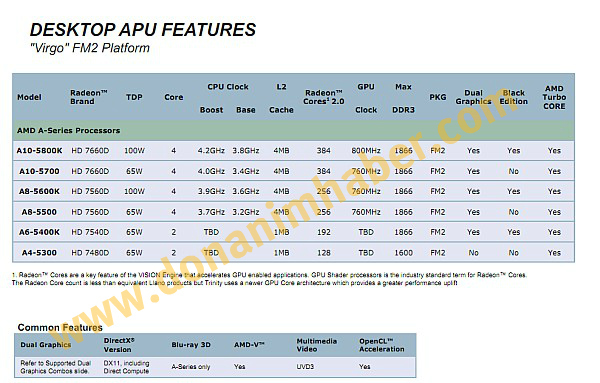
DonanimHaber scored a specifications-sheet that details all the models
AMD has in store for this year, also giving us an insight to what
constitute each of these model numbers.
An interesting revelation here is that AMD does not have triple-core APUs anywhere in its lineup. The A10 lineup consists of quad-core APUs that come with Radeon HD 7660D graphics, while the A8 lineup also consists of quad-core APUs, but with slower Radeon HD 7560D graphics. The A6 lineup consists of dual-core APUs with Radeon HD 7540D graphics, while the A4 lineup has dual-core APUs with Radeon HD 7480D graphics.
The HD 7660D has 384 Graphics CoreNext stream processors, HD 7560D has 256 of these, the HD 7540D has 192, and the HD 7480D has 128. The HD 7480D also lacks dual-graphics support that lets you pair the APU-embedded graphics processor with a compatible discrete GPU to make the two work in tandem. While these GPUs have comparatively lower stream processors than previous-generation "Llano", performance increase is made up for by the more advanced GPU architecture, and higher GPU core speeds.
Leading the chart is the A10-5800K, designed for gamers and overclockers on a tight budget. This chip packs 4 "Piledriver" architecture cores (based in two modules), with 3.80 GHz (stock) and 4.20 GHz (TurboCore) frequency, 4 MB total cache, and Radeon HD 7660D graphics. This chip bears the Black Edition branding, and hence features an unlocked base clock multiplier that helps with overclocking. This is followed by the non-Black Edition A10-5700 clocked at 3.40 GHz with 4.00 GHz TurboCore.
The A10-5800K is not the only Black Edition part, there's also the A8-5600K, which bears clock speeds of 3.60 GHz (stock), 3.90 (TurboCore) and A6-5400K, both of which feature the unlocked base clock multiplier; Just below the A8-5600K is the A8-5500, with 3.20 GHz (stock), 3.70 GHz (TurboCore). The cheapest of the lot will be the A4-5300. The clock speeds of the A6 and A4 parts were not revealed.
Source: DonanimHaber
An interesting revelation here is that AMD does not have triple-core APUs anywhere in its lineup. The A10 lineup consists of quad-core APUs that come with Radeon HD 7660D graphics, while the A8 lineup also consists of quad-core APUs, but with slower Radeon HD 7560D graphics. The A6 lineup consists of dual-core APUs with Radeon HD 7540D graphics, while the A4 lineup has dual-core APUs with Radeon HD 7480D graphics.
The HD 7660D has 384 Graphics CoreNext stream processors, HD 7560D has 256 of these, the HD 7540D has 192, and the HD 7480D has 128. The HD 7480D also lacks dual-graphics support that lets you pair the APU-embedded graphics processor with a compatible discrete GPU to make the two work in tandem. While these GPUs have comparatively lower stream processors than previous-generation "Llano", performance increase is made up for by the more advanced GPU architecture, and higher GPU core speeds.
Leading the chart is the A10-5800K, designed for gamers and overclockers on a tight budget. This chip packs 4 "Piledriver" architecture cores (based in two modules), with 3.80 GHz (stock) and 4.20 GHz (TurboCore) frequency, 4 MB total cache, and Radeon HD 7660D graphics. This chip bears the Black Edition branding, and hence features an unlocked base clock multiplier that helps with overclocking. This is followed by the non-Black Edition A10-5700 clocked at 3.40 GHz with 4.00 GHz TurboCore.
The A10-5800K is not the only Black Edition part, there's also the A8-5600K, which bears clock speeds of 3.60 GHz (stock), 3.90 (TurboCore) and A6-5400K, both of which feature the unlocked base clock multiplier; Just below the A8-5600K is the A8-5500, with 3.20 GHz (stock), 3.70 GHz (TurboCore). The cheapest of the lot will be the A4-5300. The clock speeds of the A6 and A4 parts were not revealed.
Source: DonanimHaber
Wednesday, February 8, 2012
AMD Introduces the FirePro V3900 Professional Graphics Card
AMD today launched the AMD FirePro V3900, which enables best-in-class
workstation experiences at an entry-level price point. By leveraging
AMD's latest graphics features, including AMD Eyefinity technology, the
AMD FirePro V3900 provides up to 95% better application performance than
the competition. The AMD FirePro V3900 will be available in select
workstation systems today and will be sold for USD$119 MSRP at select
online resellers.
"The AMD FirePro V3900 is the most powerful entry-level professional graphics card on the market today," says Sandeep Gupte, general manager of Professional Graphics, AMD. "Armed with advanced multi-display capability of AMD Eyefinity technology, extensive certifications for professional applications and blazing fast performance, it offers best-in-class value for our technical and business customers."
Engineered for professionals looking for optimized graphics performance at entry-level pricing, the AMD FirePro V3900's 1 GB of DDR3 RAM drives memory bandwidth of almost 29 GB/s, maximizing GPU performance for the highest level of user experience.3 And through AMD's productive relationship with workstation solution providers, graphics professionals will have access to the AMD FirePro V3900 in a range of industry-leading systems from HP and others.
"HP makes workstations that meet the needs of the world's most demanding customers and feature the latest technologies," says Jeff Wood, vice president of Worldwide Marketing, Commercial Solutions Business Unit, HP. "The AMD FirePro V3900, in combination with our HP Z Workstations, offers robust performance for professional workstation applications, providing HP customers with a seamless user experience at an affordable price."
AMD FirePro products are tested and certified with many leading software applications to ensure compatibility, stability, and optimal performance. OpenGL 4.2 and OpenCL support means users can render and manipulate models using the broadest range of tools and applications and know the graphics card is compatible with current and future software applications.
"The AMD FirePro V3900 certainly delivers the performance, reliability and compatibility that CAD professionals are looking for when undertaking the latest design projects," said Nick Iwaskow, Senior Alliances & Partnership Manager, DS SolidWorks Corp. "Coupled with the best 3D CAD solutions from Dassault Systèmes SolidWorks Corp. it can enhance the design process for professionals everywhere."
The AMD FirePro V3900 has received certification for a variety of applications including AutoCAD, UGS NX, PTC Creo, SolidWorks and Autodesk 3Ds Max.
Specs sheet courtesy of HotHardware.
Source
"The AMD FirePro V3900 is the most powerful entry-level professional graphics card on the market today," says Sandeep Gupte, general manager of Professional Graphics, AMD. "Armed with advanced multi-display capability of AMD Eyefinity technology, extensive certifications for professional applications and blazing fast performance, it offers best-in-class value for our technical and business customers."
Engineered for professionals looking for optimized graphics performance at entry-level pricing, the AMD FirePro V3900's 1 GB of DDR3 RAM drives memory bandwidth of almost 29 GB/s, maximizing GPU performance for the highest level of user experience.3 And through AMD's productive relationship with workstation solution providers, graphics professionals will have access to the AMD FirePro V3900 in a range of industry-leading systems from HP and others.
"HP makes workstations that meet the needs of the world's most demanding customers and feature the latest technologies," says Jeff Wood, vice president of Worldwide Marketing, Commercial Solutions Business Unit, HP. "The AMD FirePro V3900, in combination with our HP Z Workstations, offers robust performance for professional workstation applications, providing HP customers with a seamless user experience at an affordable price."
AMD FirePro products are tested and certified with many leading software applications to ensure compatibility, stability, and optimal performance. OpenGL 4.2 and OpenCL support means users can render and manipulate models using the broadest range of tools and applications and know the graphics card is compatible with current and future software applications.
"The AMD FirePro V3900 certainly delivers the performance, reliability and compatibility that CAD professionals are looking for when undertaking the latest design projects," said Nick Iwaskow, Senior Alliances & Partnership Manager, DS SolidWorks Corp. "Coupled with the best 3D CAD solutions from Dassault Systèmes SolidWorks Corp. it can enhance the design process for professionals everywhere."
The AMD FirePro V3900 has received certification for a variety of applications including AutoCAD, UGS NX, PTC Creo, SolidWorks and Autodesk 3Ds Max.
Specs sheet courtesy of HotHardware.
Source
Friday, February 3, 2012
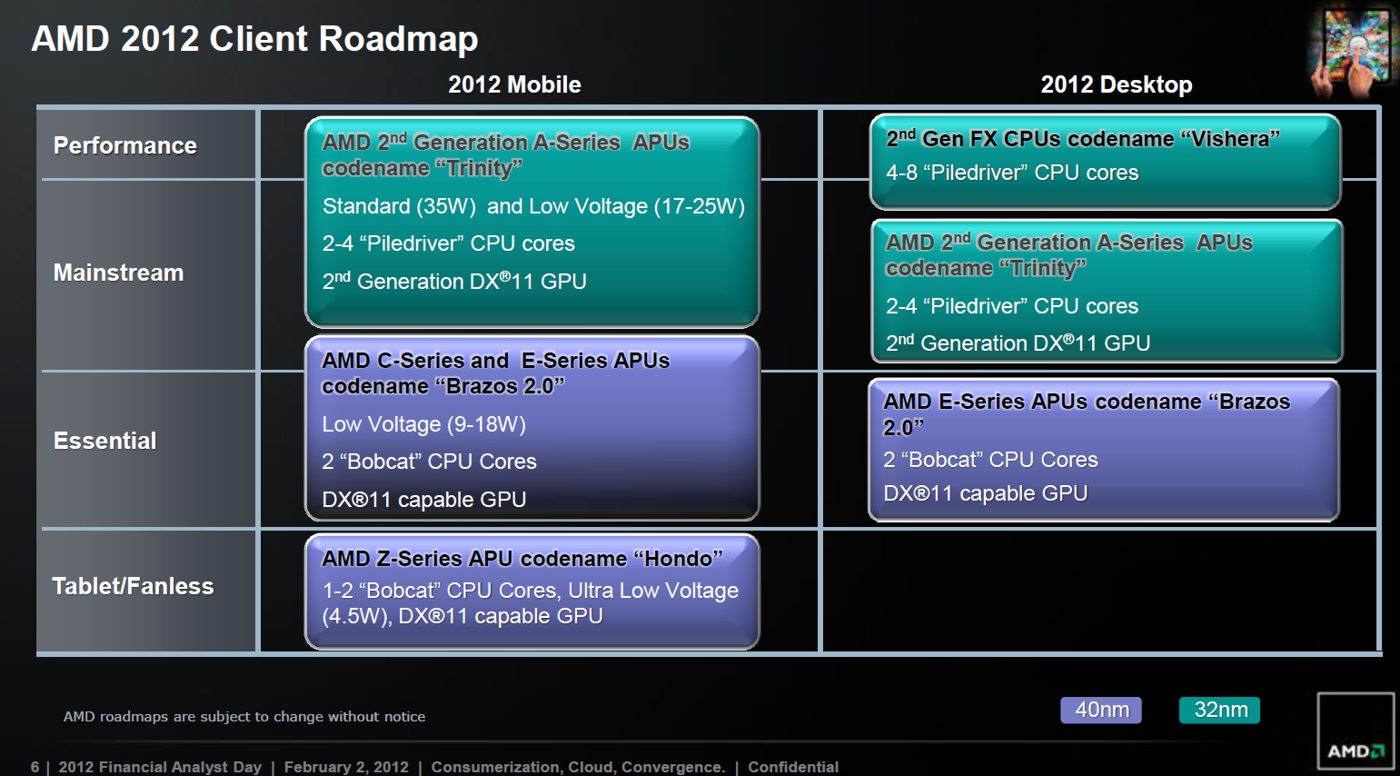
AMD Outlines Its 2012-2013 Client Roadmap, Big Focus is on APUs
At its annual Financial Analyst Day, AMD has presented an updated
roadmap detailing the hardware it plans to bring to the table during
2012 and 2013. For this year, the Sunnyvale-based company is preparing a
processor quarter which includes the Trinity, Brazos 2.0 and Hondo APUs
(accelerated processing units) and the Vishera CPU.
Set to be the main weapon in AMD's x86 arsenal, the Trinity APU (aka the 2nd gen A Series) is made on 32 nm process technology, and features DirectX 11 graphics, two/four Piledriver cores (Piledrive is said to deliver 25% better performance than the Stars cores found in Llano APUs), and a TDP that can go as low as 17 W on mobile parts. Trinity is expected to debut in Q2 and already has close to 100 design wins (more than Llano had before its release).
The Brazos 2.0 (C and E Series) and Hondo (Z Series) APUs are 40 nm parts and feature up to two Bobcat cores, DirectX 11 graphics, and a TDP going from 4.5 W to 18 W. These are designed for low-power/low-cost mobile and desktop devices.
On the CPU front 2012 will see to the arrival of the 32 nm Vishera parts (2nd gen FX Series) which will feature 4, 6 or 8 Piledriver cores. Interestingly-enough, Vishera is listed as the sole CPU for 2013 desktops too so it seems AMD won't be doing much in this segment, apart from maybe releasing higher-clocked models.
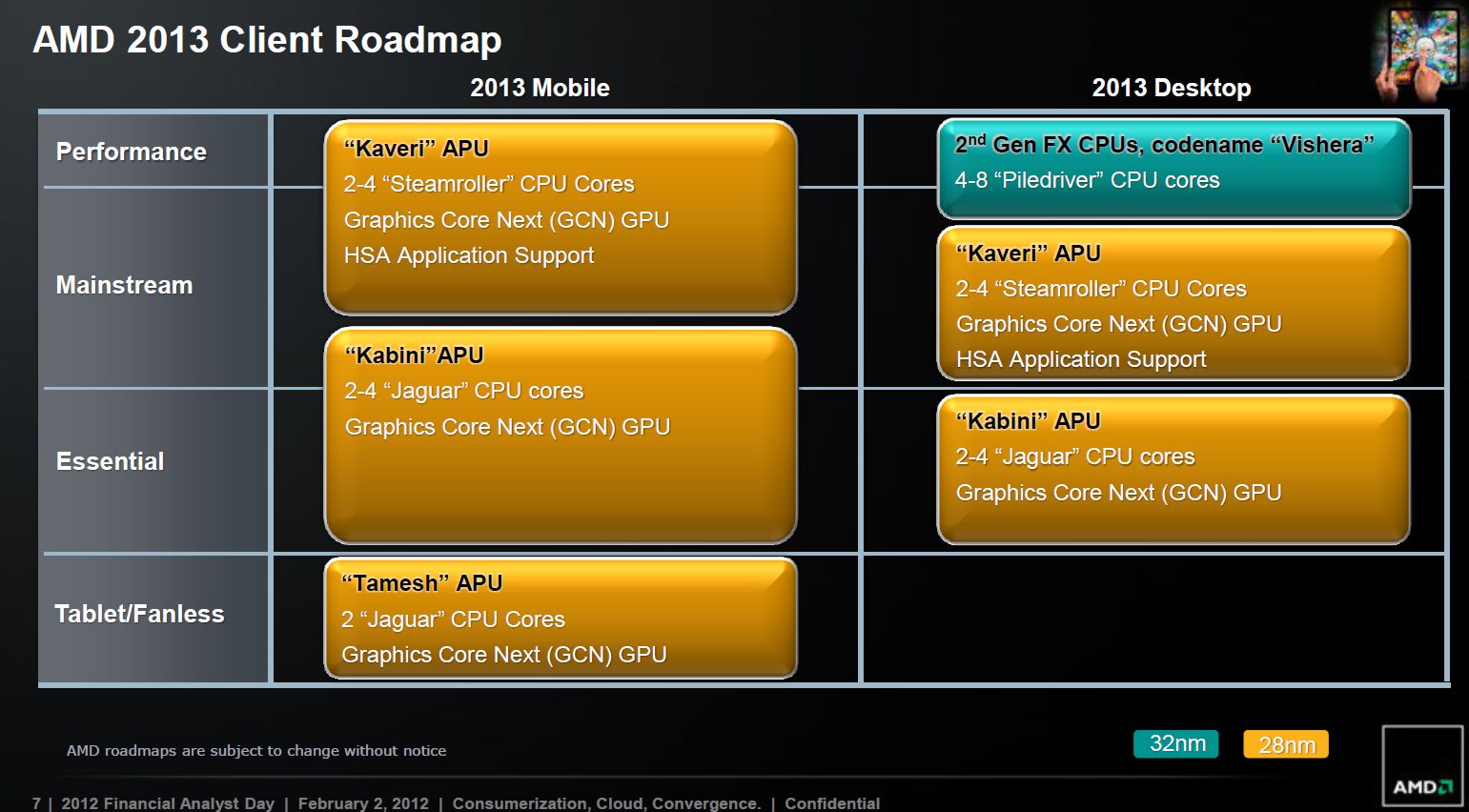
For 2013 AMD is readying a LOT of 28 nm chips, including the Sea Islands GPUs - said to have a 'new architecture' and HSA (Heterogeneous Systems Architecture) features, and the Kaveri, Kabini and Temash APUs.
Kaveri is Trinity's successor and it will feature a DirectX 11.1-supporting (GCN-based) GPU, 2 to 4 Steamroller x86 cores, and HSA application support. Kaveri will cover the mainstream mobile and desktop segment so Kabini and Temash will focus on lower-cost/lower-power hardware.
Both Kabini and Tamesh will have GCN graphics and will make use of Jaguar x86 cores. Kabini will have up to four x86 cores while Tamesh will feature two. No ARM in sight here, maybe we'll have to wait a bit more.
Source: PC Perspective
Set to be the main weapon in AMD's x86 arsenal, the Trinity APU (aka the 2nd gen A Series) is made on 32 nm process technology, and features DirectX 11 graphics, two/four Piledriver cores (Piledrive is said to deliver 25% better performance than the Stars cores found in Llano APUs), and a TDP that can go as low as 17 W on mobile parts. Trinity is expected to debut in Q2 and already has close to 100 design wins (more than Llano had before its release).
The Brazos 2.0 (C and E Series) and Hondo (Z Series) APUs are 40 nm parts and feature up to two Bobcat cores, DirectX 11 graphics, and a TDP going from 4.5 W to 18 W. These are designed for low-power/low-cost mobile and desktop devices.
On the CPU front 2012 will see to the arrival of the 32 nm Vishera parts (2nd gen FX Series) which will feature 4, 6 or 8 Piledriver cores. Interestingly-enough, Vishera is listed as the sole CPU for 2013 desktops too so it seems AMD won't be doing much in this segment, apart from maybe releasing higher-clocked models.
For 2013 AMD is readying a LOT of 28 nm chips, including the Sea Islands GPUs - said to have a 'new architecture' and HSA (Heterogeneous Systems Architecture) features, and the Kaveri, Kabini and Temash APUs.
Kaveri is Trinity's successor and it will feature a DirectX 11.1-supporting (GCN-based) GPU, 2 to 4 Steamroller x86 cores, and HSA application support. Kaveri will cover the mainstream mobile and desktop segment so Kabini and Temash will focus on lower-cost/lower-power hardware.
Both Kabini and Tamesh will have GCN graphics and will make use of Jaguar x86 cores. Kabini will have up to four x86 cores while Tamesh will feature two. No ARM in sight here, maybe we'll have to wait a bit more.
Source: PC Perspective
AMD A8-3870K Cracks 6 GHz with All Cores Enabled
Overclocker "Christian Ney" of the HWBOT community claims to have
cracked the 6 GHz clock speed mark with an AMD A8-3870K APU, with all
four of its cores enabled. The feat consisted of a clock speed of 6067.7
MHz achieved using a base clock of 258.2 MHz and multiplier of 47.0x.
The memory was clocked at 3505 MHz, just 95 MHz short of a world-record.
The chip was put through a scorching core voltage of 2V. Supporting
components included GIGABYTE A75-UD4H motherboard, and GeIL EVO Corsa
DDR3 memory. The setup was cooled sub-zero. CPU-Z Validator rejected
this submission, probably because like us, it finds 2V vCore and 258.2
MHz base clock unreal for Llano, since it uses a common 100 MHz clock
domain for BClk and PCIe.
Source: MyDrivers.com
Tuesday, January 17, 2012
AMD Announces the First AMD Fusion Center of Innovation
AMD today announced the first AMD Fusion Center of Innovation at the
University of Illinois at Urbana-Champaign, designed to focus on the
innovative developer environment and software performance advancements
enabled by heterogeneous computing. The center will fund, mentor and
promote new commercial enterprises emerging from the vast intellectual
property and research expertise in the University of Illinois community.
The University has been a hotbed of new start-ups since the creation of the first widespread web browser - Mosaic - developed by Marc Andreessen in 1992. Through access to AMD Accelerated Processing Unit (APU) technology and platforms, the AMD Fusion Center of Innovation will help bridge access to new AMD heterogeneous computing technology with the innovative spirit stimulated and nurtured on campus.
To kick-off the AMD Fusion Center of Innovation, the University of Illinois at Urbana-Champaign is offering a course aimed at kindling the spirit of entrepreneurship by bringing a mix of expert speakers to cover the specifics of AMD heterogeneous computing technology, while also providing invaluable, how-to background on entrepreneurship, commercialization and start-up creation. This course will be offered by the university's College of Engineering, Technology Entrepreneur Center (TEC), as "ENG/TE 360/460: Lectures in Engineering Entrepreneurship AMD Section."
At the completion of the course, students will submit projects which will be evaluated for potential funding opportunities through the AMD Fusion Fund and IllinoisVENTURES. Computer science and engineering students are encouraged to share their best ideas for new software or web-based start-up companies.
"Through their involvement with the Technology Entrepreneur Center, companies like AMD are helping to further develop the Illinois entrepreneurship ecosystem here in the Midwest," said Andrew Singer, Professor, Department of Electrical and Computer Engineering, and Director, Technology Entrepreneur Center, at the University of Illinois at Urbana-Champaign. "Offering the latest innovative computing hardware and software technologies and bringing them into the classroom, where students can apply their ideas and form new ventures will be a great advantage for the generation of new innovative ideas that can be commercialized through the AMD Fusion Center of Innovation."
Rob Schultz, senior director of IllinoisVENTURES and a partner of the Illinois Emerging Technologies Fund said, "We are encouraging the university community to think big about what's possible through software and web services by focusing on the creative aspects. The AMD Fusion Center of Innovation will provide a spark for new software and web ideas as students receive hands-on access to AMD APU technology and learn how to enable richer user experiences using heterogeneous computing."
AMD APU technology combines a multi-core CPU and discrete-level GPU and other hardware accelerators on a single power-efficient chip enabling user interface innovation, vivid HD entertainment and content creation, blazing fast Internet browsing and accelerated media applications. Consumers can enjoy rich, smooth performance, skip-free HD playback and discover impressive speed and performance in everyday applications on their PC when using AMD APU technology.
"The AMD Fusion Center of Innovation at the University of Illinois at Urbana-Champaign provides the perfect environment of academia and software development," said Manju Hegde, corporate vice president, AMD Fusion Experience Program. "We believe heterogeneous computing will be the enabler for innovative user interfaces and immersive computing experiences, which will ultimately be driven by aspiring and audacious students. The University of Illinois at Urbana-Champaign will serve as a model for future AMD Fusion Centers of Innovation around the world."
Source
The University has been a hotbed of new start-ups since the creation of the first widespread web browser - Mosaic - developed by Marc Andreessen in 1992. Through access to AMD Accelerated Processing Unit (APU) technology and platforms, the AMD Fusion Center of Innovation will help bridge access to new AMD heterogeneous computing technology with the innovative spirit stimulated and nurtured on campus.
To kick-off the AMD Fusion Center of Innovation, the University of Illinois at Urbana-Champaign is offering a course aimed at kindling the spirit of entrepreneurship by bringing a mix of expert speakers to cover the specifics of AMD heterogeneous computing technology, while also providing invaluable, how-to background on entrepreneurship, commercialization and start-up creation. This course will be offered by the university's College of Engineering, Technology Entrepreneur Center (TEC), as "ENG/TE 360/460: Lectures in Engineering Entrepreneurship AMD Section."
At the completion of the course, students will submit projects which will be evaluated for potential funding opportunities through the AMD Fusion Fund and IllinoisVENTURES. Computer science and engineering students are encouraged to share their best ideas for new software or web-based start-up companies.
"Through their involvement with the Technology Entrepreneur Center, companies like AMD are helping to further develop the Illinois entrepreneurship ecosystem here in the Midwest," said Andrew Singer, Professor, Department of Electrical and Computer Engineering, and Director, Technology Entrepreneur Center, at the University of Illinois at Urbana-Champaign. "Offering the latest innovative computing hardware and software technologies and bringing them into the classroom, where students can apply their ideas and form new ventures will be a great advantage for the generation of new innovative ideas that can be commercialized through the AMD Fusion Center of Innovation."
Rob Schultz, senior director of IllinoisVENTURES and a partner of the Illinois Emerging Technologies Fund said, "We are encouraging the university community to think big about what's possible through software and web services by focusing on the creative aspects. The AMD Fusion Center of Innovation will provide a spark for new software and web ideas as students receive hands-on access to AMD APU technology and learn how to enable richer user experiences using heterogeneous computing."
AMD APU technology combines a multi-core CPU and discrete-level GPU and other hardware accelerators on a single power-efficient chip enabling user interface innovation, vivid HD entertainment and content creation, blazing fast Internet browsing and accelerated media applications. Consumers can enjoy rich, smooth performance, skip-free HD playback and discover impressive speed and performance in everyday applications on their PC when using AMD APU technology.
"The AMD Fusion Center of Innovation at the University of Illinois at Urbana-Champaign provides the perfect environment of academia and software development," said Manju Hegde, corporate vice president, AMD Fusion Experience Program. "We believe heterogeneous computing will be the enabler for innovative user interfaces and immersive computing experiences, which will ultimately be driven by aspiring and audacious students. The University of Illinois at Urbana-Champaign will serve as a model for future AMD Fusion Centers of Innovation around the world."
Source
AMD's Ultrabook-Equivalent Platform Up To 20% Cheaper
While many might think that "Ultrabook" is a generic term for a new
performance ultra-portable notebook form-factor, it is a registered
trademark of Intel, which governs the specifications of what qualifies
to be an Ultrabook. Intel will launch a well-defined Ultrabook platform
based on its third-generation Core processor family, codenamed "Ivy
Bridge", later this year. Meanwhile, AMD is finalizing a performance
ultra-portable specification of its own, powered by its next-generation
"Trinity" accelerated processing units (APUs), which it will call
"Ultrathin".
Ultrathin will be designed to offer competitive CPU performance to Ultrabook, and superior GPU performance to it, at target prices 10-20 percent lower than Ultrabook. In 2012, while Intel bagged about 75 design wins for its Ultrabook platform, AMD claims to have already won 20. AMD's Ultrathin platform will have advantages over Intel's Ultrathin with regards to platform and component costs. The average AMD Ultrathin with $100~$200 cheaper than the average Intel Ultrabook. Some notebook vendors are concerned that a competitive platform to Intel Ultrabook could result in a price-war between the two platforms, and end up reducing the prices of the now profitable-looking performance ultraportable segment.
Source: DigiTimes
Ultrathin will be designed to offer competitive CPU performance to Ultrabook, and superior GPU performance to it, at target prices 10-20 percent lower than Ultrabook. In 2012, while Intel bagged about 75 design wins for its Ultrabook platform, AMD claims to have already won 20. AMD's Ultrathin platform will have advantages over Intel's Ultrathin with regards to platform and component costs. The average AMD Ultrathin with $100~$200 cheaper than the average Intel Ultrabook. Some notebook vendors are concerned that a competitive platform to Intel Ultrabook could result in a price-war between the two platforms, and end up reducing the prices of the now profitable-looking performance ultraportable segment.
Source: DigiTimes
Sunday, January 15, 2012
AMD FX-8150 Tested with Latest Windows Hotfixes, Still No Improvement
German tech website TweakPC did a before-after comparison of applying
Microsoft's recently-released KB2645594 + KB2646060 Windows updates,
which intend to improve performance of systems running AMD FX
processors, by improving the way in which the OS deals with Bulldozer
cores, using a top-of-the-line FX-8150 processor. The reviewer put
FX-8150 through synthetic tests such as AIDA64 (CPU benchmarks, FPU
benchmarks), Cinebench 11.5, MaxxPi (multi-threaded PI calculations),
WPrime, Twofish AES, 3DMark (Vantage and 11), ComputeMark; and some
real-world tests such as WinRAR, Resident Evil 5, and Battleforge.
Barring Resident Evil 5, where the patched FX-8150 produced 4% higher
performance and WinRAR, where it produced 3% higher performance, there
were no significant performance gains noticed. The review can be
accessed at the source.
Source: TweakPC.de
Source: TweakPC.de
AMD to Release 28 nm Mobile GPUs in Q2
This week the desktop space has officially entered the 28 nm GPU era
thanks to the retail release of the Radeon HD 7970. It's a significant
milestone for the discrete graphics market and for AMD, but it's only
the beginning as the Sunnyvale-based company is currently preparing the
arrival of the Radeon HD 7950 and is planning the introduction of the
first 28 nm mobile chips.
While the HD 7950 will debut this quarter, the 28 nm GPUs for notebooks will have to wait a little longer, until Q2. The upcoming mobile parts are of course based on the GCN architecture and will bring DirectX 11.1 support, as well as power, image quality and display output enhancements.
The 28 nm mobile cards will (most) likely be added to the recently-introduced Radeon HD 7000M family which also includes multiple 40 nm-based cards (7600M, 7500M, 7400M, 7300M). Look for 28 nm models to be branded Radeon HD 7700M and higher.
Source: ComputerBase
While the HD 7950 will debut this quarter, the 28 nm GPUs for notebooks will have to wait a little longer, until Q2. The upcoming mobile parts are of course based on the GCN architecture and will bring DirectX 11.1 support, as well as power, image quality and display output enhancements.
The 28 nm mobile cards will (most) likely be added to the recently-introduced Radeon HD 7000M family which also includes multiple 40 nm-based cards (7600M, 7500M, 7400M, 7300M). Look for 28 nm models to be branded Radeon HD 7700M and higher.
Source: ComputerBase
Sunday, January 8, 2012
More AMD Radeon HD 7000 OEM Products Surface
Apparently, HD 7670 OEM
isn't the only product that couldn't survive the prying eyes of the
media, there are more. AMD's lineup of HD 7000 series OEM solutions
extends downwards way beyond the HD 7670 OEM, it includes HD 7570, HD
7470, HD 7450, and HD 7350. There's no reason to cheer, though. First,
these products are available only in the OEM channels, to pre-built
system manufacturers so they could spice their specs sheets up; and
second, they're complete re-brands of previous generation HD 6500, 6400,
and 6300 families, down to the clock speeds and feature-sets. There are
absolutely no HD 7000 series features, no DirectX 11.1, ZeroCore, new
media-processing capabilities, nothing. The fineprint of their
specifications is tabled below. Details of these chips can be accessed here.
Source: Tom's Hardware
AMD Catalyst 12.1a Preview Driver and 11.12 CAP2
AMD have released a double dose of goodies this time round, so let's start with the 12.1a preview driver.
It includes all the features found in the 12.1 preview and has a small
number of improvements for Rage, which while sounding modest, can
actually improve game play significantly for systems affected by these
problems. The driver applies to HD 6000 & HD 5000 series graphics
cards only.
DOWNLOADS AMD Catalyst 12.1a Preview driver for Windows vista & Windows 7, AMD Catalyst 12.1a Preview driver for Windows XP, 11.12 CAP2
- Resolves some new texture corruption issues introduced by the latest version of the game
- Improved performance ~5%
- Smoother game play and reduces multicore sync points
- Fixed mapbuffer failures when switching maps on 32-bit systems.
- Fixed a game crash when switching maps back and forth on 32 and 64-bit systems
DOWNLOADS AMD Catalyst 12.1a Preview driver for Windows vista & Windows 7, AMD Catalyst 12.1a Preview driver for Windows XP, 11.12 CAP2
Friday, December 30, 2011
More HD 7770 Leaks: Pictures, Plus 3DMark Benchmarks
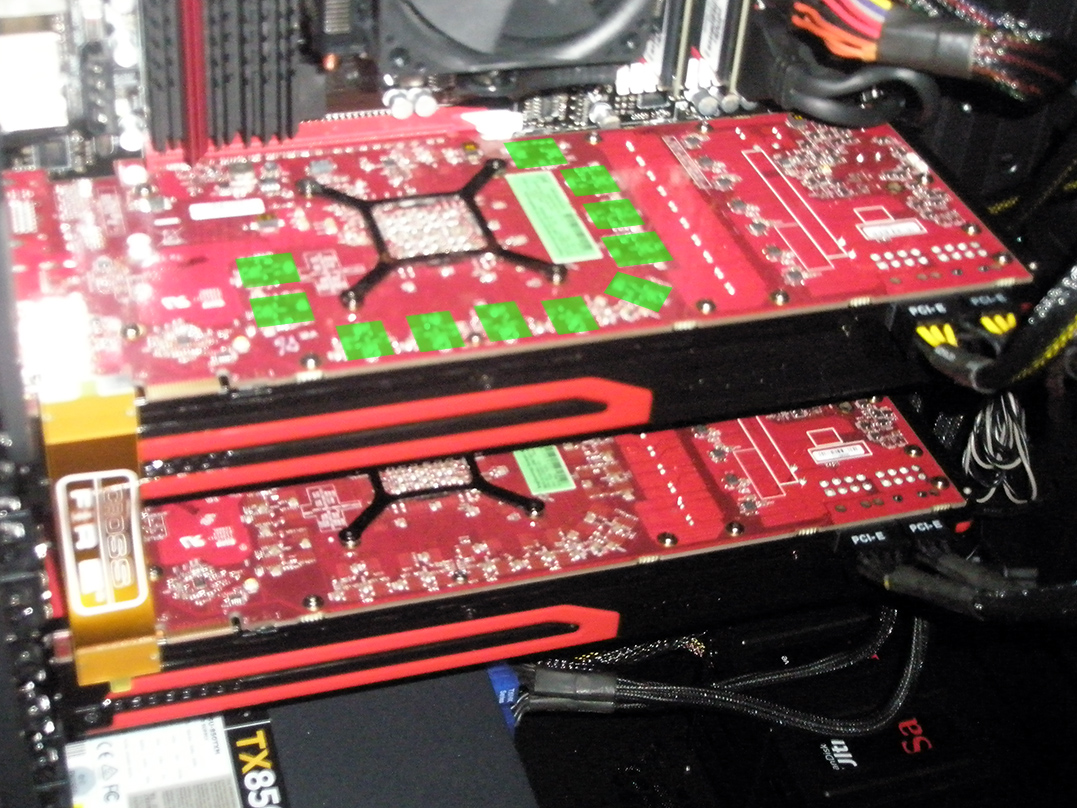
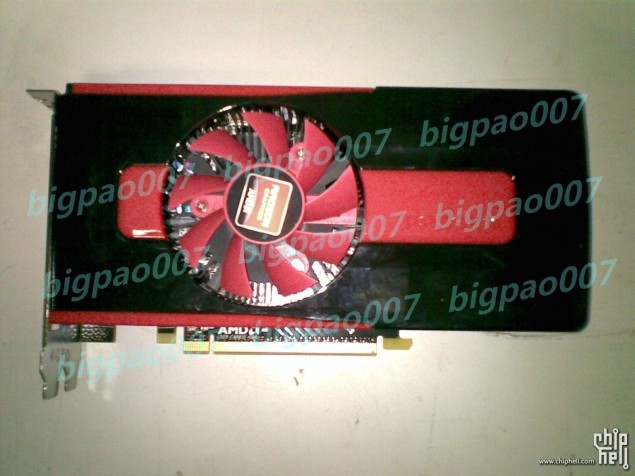
Not quite two weeks ago, we reported
on leaked pictures of AMD's upcoming Radeon HD 7770 mid-range graphics
card based on the new Southern Islands architecture and listed its basic
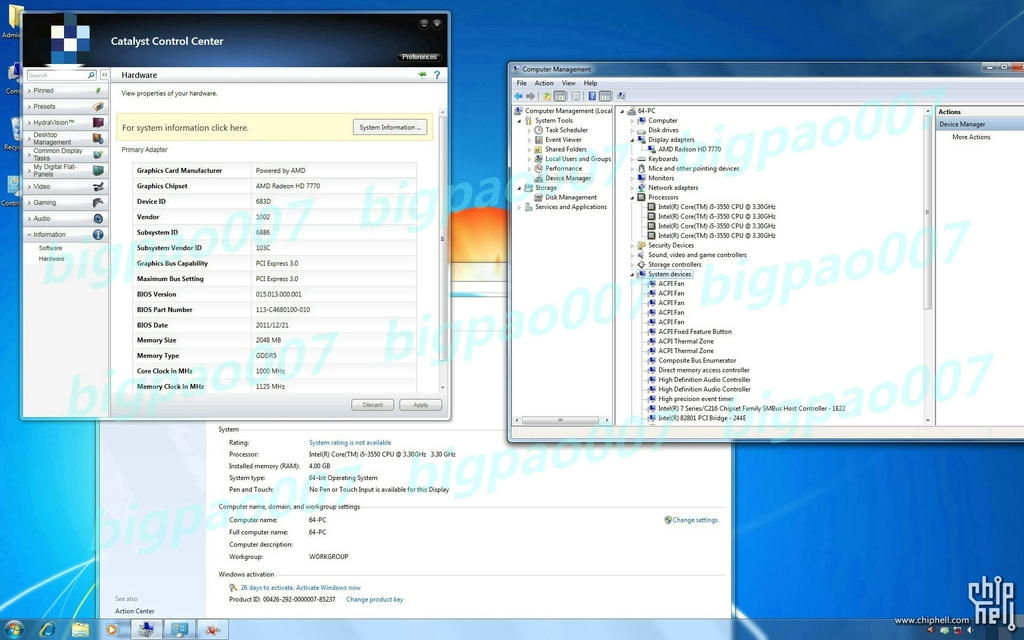
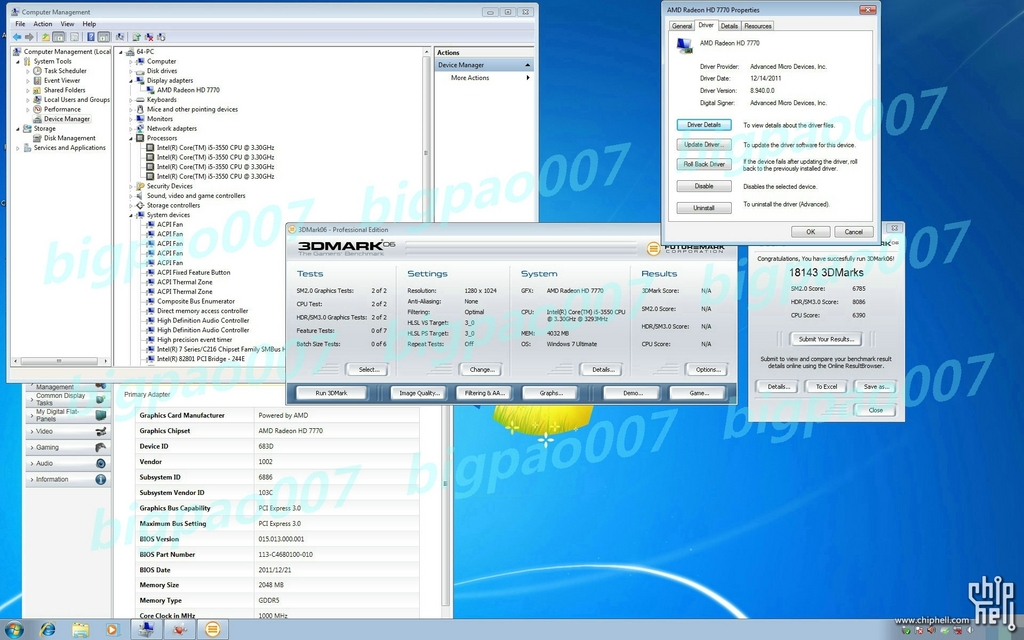
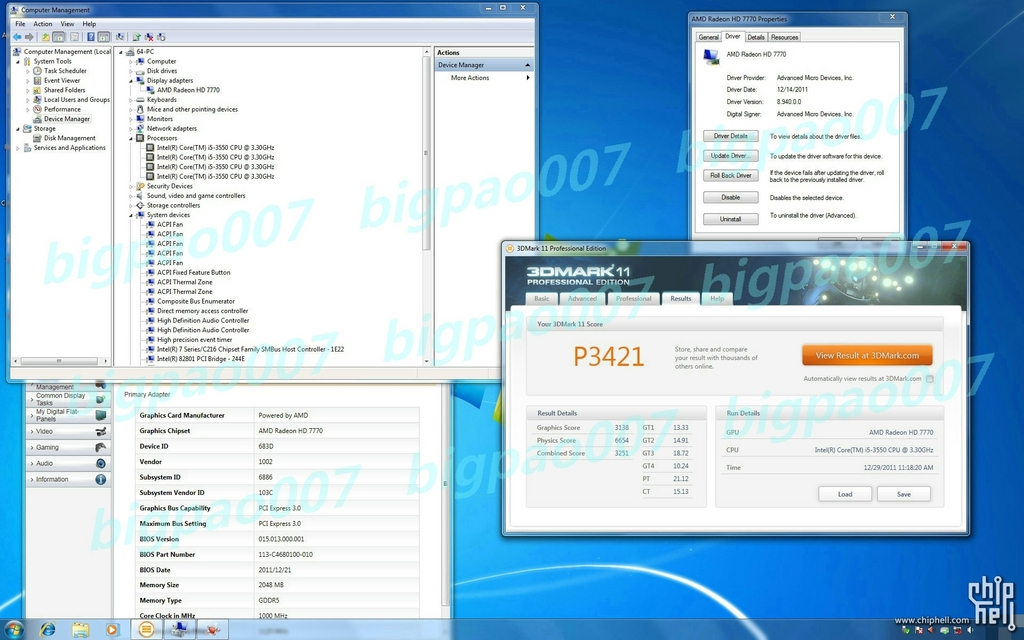
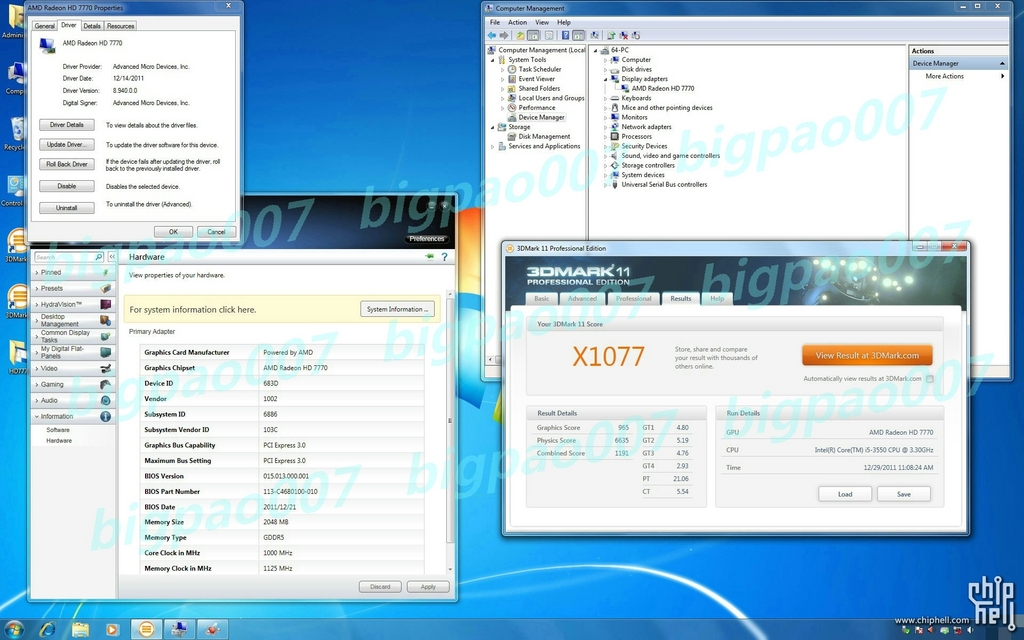
specs. Well, the leaks keep coming and bigpao007 of ChipHell has leaked
more pictures with some benchmarks to go with them. The test setup
consisted of an Ivy Bridge ES CPU – Core i5-3550K at 3.3Ghz and Z77
chipset-based motherboard. The driver used was the AMD Catalyst 8.940
RC2, giving the following 3DMark benchmark results:
3DMark 06:
HD7770 (Stock @ 1Ghz): 18143 3D Marks (SM2.0: 6785/HDR: 8086/CPU: 6390)
3DMark 11 (Performance Preset):
HD7770 (Stock @ 1Ghz): P3421 (3138 Graphics Score)
3DMark 11 (Extreme Preset):
HD7770 (Stock @ 1Ghz): X1077 (965 Graphics Score)
Screenshots follow:
Source: techngaming.com
3DMark 06:
HD7770 (Stock @ 1Ghz): 18143 3D Marks (SM2.0: 6785/HDR: 8086/CPU: 6390)
3DMark 11 (Performance Preset):
HD7770 (Stock @ 1Ghz): P3421 (3138 Graphics Score)
3DMark 11 (Extreme Preset):
HD7770 (Stock @ 1Ghz): X1077 (965 Graphics Score)
Screenshots follow:
Source: techngaming.com
Wednesday, December 21, 2011
AMD Announces New A-Series Accelerated Processing Units (APUs)
AMD today updated its A-Series line-up of desktop and notebook
Accelerated Processing Units (APUs), further improving its
top-performing family of dual- and quad-core APUs. Along with speed and
performance improvements, AMD Steady Video update make this unique
feature more compelling than ever. For desktop users, AMD extends its
overclocking pedigree to the APU; for the first time users can tune both
x86 and graphics settings in a single processor for boosted
performance.
The updated AMD A-Series APUs combine up to four x86 CPU cores with up to 400 Radeon cores, delivering powerful DirectX 11-capable, discrete-level graphics and dedicated HD video processing on a single chip. These new APUs increase performance and deliver a richer feature set than existing AMD A-series APUs. Plus, only AMD APUs offer AMD Dual Graphics for an up to 144 percent visual performance boost when a select APU is paired with a select AMD Radeon HD 6500 Series graphics card.
The AMD A-Series family of APUs also features AMD Steady Video, designed to stabilize videos during playback – making unsteady, jumpy content look steady and smooth as you watch. On select systems using AMD A-Series APUs, Internet Explorer 9 will include an AMD Steady Video plugin, unlocking one-click control to simplify access to the premium AMD Steady Video feature for video stabilization.
All AMD A-Series processors are powered by AMD VISION Engine Software, a suite of software that provides end-users with regular updates designed to improve system performance and stability, and can add new software enhancements.
New A-Series Desktop APUs launched today:
Desktop APUs in the component channel as well as systems based on the new AMD A-Series APUs will hit the retail market over the next several weeks.
Source
The updated AMD A-Series APUs combine up to four x86 CPU cores with up to 400 Radeon cores, delivering powerful DirectX 11-capable, discrete-level graphics and dedicated HD video processing on a single chip. These new APUs increase performance and deliver a richer feature set than existing AMD A-series APUs. Plus, only AMD APUs offer AMD Dual Graphics for an up to 144 percent visual performance boost when a select APU is paired with a select AMD Radeon HD 6500 Series graphics card.
The AMD A-Series family of APUs also features AMD Steady Video, designed to stabilize videos during playback – making unsteady, jumpy content look steady and smooth as you watch. On select systems using AMD A-Series APUs, Internet Explorer 9 will include an AMD Steady Video plugin, unlocking one-click control to simplify access to the premium AMD Steady Video feature for video stabilization.
All AMD A-Series processors are powered by AMD VISION Engine Software, a suite of software that provides end-users with regular updates designed to improve system performance and stability, and can add new software enhancements.
New A-Series Desktop APUs launched today:
- A8-3870K: Four CPU cores, 3.0 GHz CPU base (unlocked), 100W TDP, 400 Radeon cores, 600 MHz GPU base (unlocked), 4 MB L2 cache
- A8-3820: Four CPU cores, 2.5 GHz CPU base (2.8 GHz Turbo Core), 65W TDP, 400 Radeon cores, 4 MB L2 cache
- A6-3670K: Four CPU cores, 2.7 GHz CPU base (unlocked), 100W TDP, 320 Radeon cores, 600 MHz GPU base (unlocked), 4 MB L2 cache
- A6-3620: Four CPU cores, 2.2 GHz CPU base (2.5 GHz Turbo Core), 65W TDP, 320 Radeon cores, 4 MB L2 cache
- A4-3420: Two CPU cores, 2.8 GHz CPU base, 65W TDP, 160 Radeon cores, 1 MB L2 cache
- A8-3550MX: Four CPU cores, 2.0 GHz CPU base (2.7 GHz Turbo Core), 45W TDP, 400 Radeon Cores, 4 MB L2 cache
- A8-3520M: Four CPU cores, 1.6 GHz CPU base (2.5 GHz Turbo Core), 35W TDP, 400 Radeon Cores, 4 MB L2 cache
- A6-3430MX: Four CPU cores, 1.7 GHz CPU base (2.4 GHz Turbo Core), 45W TDP, 320 Radeon Cores, 4 MB L2 cache
- A6-3420M: Four CPU cores, 1.5 GHz CPU base (2.4 GHz Turbo Core), 35W TDP, 320 Radeon Cores, 4 MB L2 cache
- A4-3330MX: Two CPU cores, 2.2 GHz CPU base (2.6 GHz Turbo Core), 45W TDP, 240 Radeon Cores, 2 MB L2 cache
- A4-3320M:Two CPU cores, 2.0 GHz CPU base (2.6 GHz Turbo Core), 35W TDP, 240 Radeon Cores, 2 MB L2 cache
- A4-3305M:Two CPU cores, 1.9 GHz CPU base (2.5 GHz Turbo Core), 35W TDP, 160 Radeon Cores, 1 MB L2 cache
- E2-3000M: Two CPU cores, 1.8 GHz CPU base (2.4 GHz Turbo Core), 35W TDP, 160 Radeon Cores, 1 MB L2 Cache
Desktop APUs in the component channel as well as systems based on the new AMD A-Series APUs will hit the retail market over the next several weeks.
Source
Radeon HD 6930 2 GB Tested
Unbeknownst to many, AMD launched the Radeon HD 6930 in some markets.
The company apparently doesn't want this launch to disturb reviewers
from key high-volume markets, who have their hands full with Radeon HD
7970, and so the HD 6930 got a limited launch. For one, the HD 6930 is
most certainly launched in China, and so Expreview gave it a run against
the HD 6950 1 GB. The Radeon HD 6930 is carved out of the 40 nm
"Cayman" silicon, on which other HD 6900 series products are based. It
features 1280 VLIW4 stream processors, 1 GB or 2 GB of GDDR5 memory over
a 256-bit wide memory interface, 80 TMUs, 32 ROPs, and clock speeds of
750 MHz (core), 1200 MHz or 4.80 GHz effective (memory). Very few
partners made English press-releases about this SKU, HIS was among them.
The company launched an IceQ-X graphics card on Monday.
Performance summary follows.
Expreview put the HD 6930 through its usual battery of tests, covering a large variety of games and synthetic benchmarks. The results are tabled below. Overall, the HD 6930 was found to be about 7.8% slower than the HD 6950 2 GB.
Source: Expreview
Performance summary follows.
Expreview put the HD 6930 through its usual battery of tests, covering a large variety of games and synthetic benchmarks. The results are tabled below. Overall, the HD 6930 was found to be about 7.8% slower than the HD 6950 2 GB.
Source: Expreview
AMD's Own HD 7970 Performance Expectations?
Ahead of every major GPU launch, both NVIDIA and AMD give out a document
to reviewers known as Reviewer's Guide, in which both provide
guidelines (suggestions, not instructions), to reviewers to ensure new
GPUs are given a fair testing. In such documents, the two often also
give out their own performance expectations from the GPUs they're
launching, in which they compare the new GPUs to either
previous-generation GPUs from their own brand, or from the competitors'.
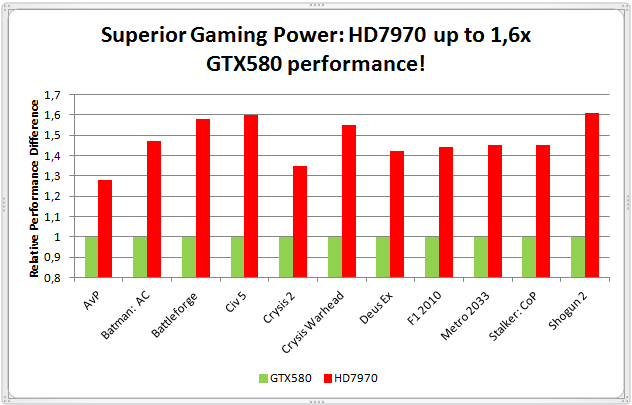
Apparently such a performance comparison between the upcoming Radeon HD
7970 and NVIDIA's GeForce GTX 580, probably part of such a document,
got leaked to the internet, which 3DCenter.org re-posted. The first
picture below, is a blurry screenshot of a graph in which the two GPUs
are compared along a variety of tests, at a resolution of 2560 x 1600. A
Tweakers.net community member recreated that graph in Excel, using that
data (second picture below).
A couple of things here are worth noting. Reviewer guide performance numbers are almost always exaggerated, so if reviewers get performance results lower than 'normal', they find it abnormal, and re-test. It's an established practice both GPUs vendors follow. Next, AMD Radeon GPUs are traditionally good at 2560 x 1600. For that matter, the performance gap between even the Radeon HD 6970 and GeForce GTX 580 narrows a bit at that resolution.
Source: 3DCenter.org
A couple of things here are worth noting. Reviewer guide performance numbers are almost always exaggerated, so if reviewers get performance results lower than 'normal', they find it abnormal, and re-test. It's an established practice both GPUs vendors follow. Next, AMD Radeon GPUs are traditionally good at 2560 x 1600. For that matter, the performance gap between even the Radeon HD 6970 and GeForce GTX 580 narrows a bit at that resolution.
Source: 3DCenter.org
Friday, December 16, 2011
AMD's Radeon HD 7970 Launch to December 22
In a surprising move, AMD pulled the launch date of Radeon HD 7970, a
high-performance single-GPU graphics card based on the 28 nm Tahiti
silicon, up to December 22, 2011; from its earlier launch date of
January 09, 2012. The January date was a lot more than speculation, as
older presentation slides from AMD to distributors and retailers talked
specifically about it. The move to pull December 22 (next Thursday)
spices things up in the run up for CES. First, it gives AIB partners
full freedom to show off their custom-design graphics cards at the
event, along with full details about GPU specifications and clock
speeds.
According to a VR-Zone report, Radeon HD 7970 will launch on December 22, 2011, this will be the day you will be able to read reviews of the card (at least the AMD reference design board), online. It will be a limited launch (read: paper-launch), but one can expect "full" retail availability of the card by January 09. Another interesting bit of information is concerning the Radeon HD 7950. This card will be available in non-reference board designs from day one, it will however launch on January 09.
Source: VR-Zone
According to a VR-Zone report, Radeon HD 7970 will launch on December 22, 2011, this will be the day you will be able to read reviews of the card (at least the AMD reference design board), online. It will be a limited launch (read: paper-launch), but one can expect "full" retail availability of the card by January 09. Another interesting bit of information is concerning the Radeon HD 7950. This card will be available in non-reference board designs from day one, it will however launch on January 09.
Source: VR-Zone
Subscribe to:
Posts (Atom)