Showing posts with label Nvidia. Show all posts

Sunday, August 5, 2012

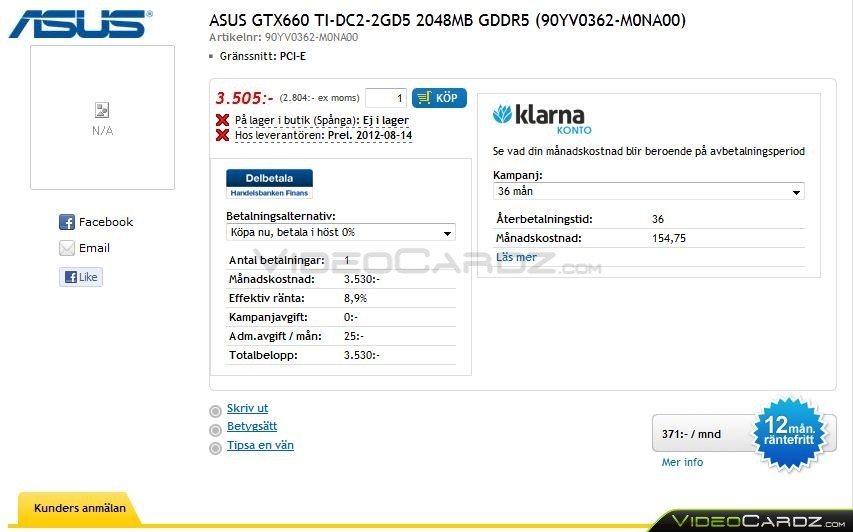
Swedish Retailers Begin Listing ASUS GeForce GTX 660 Ti DirectCU II

Several Swedish online retailers have begun listing ASUS GeForce GTX 660 Ti DirectCU II graphics card ahead of its worldwide launch. The card is listed at roughly 3,350 to 3,551 Swedish Kronor (US $492 to $521), including local taxes. The lowest price before taxes is 2,679 Kronor ($393.5). Looking at these prices, we expect US pricing to be in the $380-$420 range, before taxes. None of the retailers detailed the card, let alone post pictures of it. Based on the 28 nm GK104 silicon, the GeForce GTX 660 Ti is expected to feature 1,344 CUDA cores, and 2 GB of memory across a 192-bit wide GDDR5 memory interface.


Source: VideoCardz

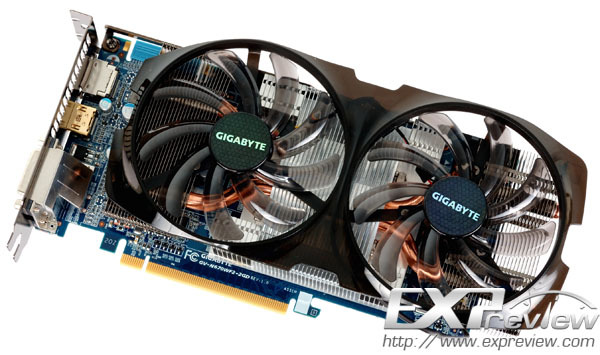
Gigabyte GeForce GTX 670 WindForce 2X Graphics Card Pictured

Here are some of the first pictures of Gigabyte GeForce GTX 670 WindForce 2X graphics card, which was released towards the end of July, without much fuss. The pictures reveal what is a combination of a non-reference design compact PCB design by Gigabyte, making use of its Ultra Durable VGA component selection (2 oz copper PCB, Japanese solid-state capacitors, binned memory chips, ferrite core chokes, low RDS (on) MOSFETs), and its WindForce 2X cooler. The PCB uses a 4+2 phase VRM to power the GK104 GPU. It draws power from two 6-pin PCIe power connectors.

The card ships in two variants, one that sticks to NVIDIA-reference clock speeds, and an OC variant (941 MHz core, 1019 MHz GPU Boost, 6.00 GHz memory). The cooler uses a compound heatsink. Its design consists of a main central aluminum heatsink which draws heat from the GPU, while two satellite aluminum fin heatsinks draw heat from the GPU through two 8 mm-thick copper heat pipes. The heatsink is ventilated by a pair of 100 mm fans, which spin at low speeds and claim low noise levels. Gigabyte's WindForce 2X graphics card is expected to cost less than its flagship WindForce 3X. Find a review at the source.


Source: Expreview

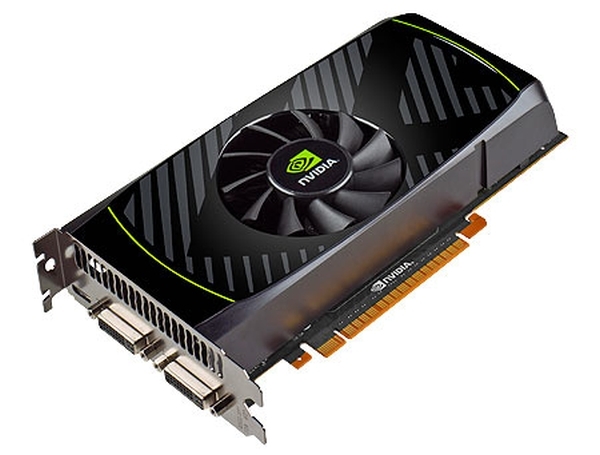
Nvidia GeForce GTX 650 Ti Specifications Detailed

A little earlier this week, specifications of NVIDIA's GeForce GTX 650 graphics processor were reported. An even newer report by DonanimHaber details its sibling, the GeForce GTX 650 Ti, designed for the sub-$250 market. The new GPU is based on the NVIDIA's newest GK106 silicon, while the GTX 650 sticks to the GK107, and is essentially a beefed-up GeForce GT 640. These are the specifications of the GeForce GTX 650 Ti we're looking at:
  • 28 nm GK106 silicon
  • 960 CUDA cores
  • 192-bit wide GDDR5 memory interface
  • 1 GB and 2 GB memory options
  • Q4-2012 launch


Source: DonanimHaber

Friday, February 17, 2012

NVIDIA Prepares GeForce GTX 560 SE to Thwart Radeon HD 7770

For an immediate relief from the market-threat looming in the sub-$200 segment with the introduction of AMD's Radeon HD 7770, NVIDIA is planning to carve out a new SKU based on the 40 nm GF114 GPU, the GeForce GTX 560 SE. The new SKU will be positioned below the GeForce GTX 560 (non-Ti), and target price-points well within $200. The new SKU is identical to the OEM-only model GeForce GTX 555. Its specifications follow:

  • Based on 40 nm GF114 ASIC
  • 288 CUDA cores
  • 48 TMUs, 24 ROPs
  • 192-bit wide GDDR5 memory interface
  • 1 GB standard memory amount (asymmetric memory chip arrangement à la GTX 550 Ti)
  • Clock speeds: 776 MHz core; 1553 MHz CUDA cores; 952 MHz (3.828 GHz effective) memory, 92 GB/s memory bandwidth
Source: VR-Zone

Friday, January 20, 2012

GeForce Kepler 104 (GK104) Packs 256-bit GDDR5 Memory Bus, 225W TDP

NVIDIA GeForce Kepler (GK104) will be NVIDIA's first high-performance GPU launched, based on its Kepler architecture. New reports suggest that this GPU, which will succeed GF114 (on which the likes of GeForce GTX 560 Ti are based), will continue to have a 256-bit wide GDDR5 memory interface. An equally recent report suggests that NVIDIA could give the front-line product based on GK104 as much as 2 GB of memory. We are also getting to hear from the INPAI report that on this product based on the GK104, the GPU will have a TDP of 225W. What's more, NVIDIA is gunning for the performance crown from AMD Radeon HD 7900 series with this chip, so it suggests that NVIDIA is designing the GK104 to have a massive performance improvement over the GF114 that it's succeeding.


Source: Inpai.com.cn

Tuesday, January 17, 2012

NVIDIA Rushing in Stopgap HD 7970 Competitor This February?

AMD's Radeon HD 7970 seems to have ruffled a few feathers at NVIDIA and it looks like the green team doesn't want too much market exposure for it. A fairly-reliable source at ChipHell learned that NVIDIA's GeForce "GTX 680" part could be launched some time in February. The source says that this part could be competitive with the HD 7970, though not exactly NVIDIA's fastest next-generation GPU in the works. So it has to be something other than the GeForce Kepler 110, that's reportedly slated for March-April. At least the tiny pieces of specifications trickling out seem to reinforce this theory. Graphics cards based on this part apparently have 2 GB of memory, and its core clock speed is reported to be 780 MHz.


Source: ChipHell

Wednesday, December 14, 2011

NVIDIA Opens Up CUDA Platform by Releasing Compiler Source Code

NVIDIA today announced that it will provide the source code for the new NVIDIA CUDA LLVM-based compiler to academic researchers and software-tool vendors, enabling them to more easily add GPU support for more programming languages and support CUDA applications on alternative processor architectures.

LLVM is a widely-used open source compiler infrastructure with a modular design that makes it easy to add support for new programming languages and processor architectures. It is used for a range of programming requirements by many leading companies, including Adobe, Apple, Cray, Electronic Arts, and others.


The new LLVM-based CUDA compiler, which is enhanced with architecture support for NVIDIA's parallel GPUs, is included in the latest release of the CUDA Toolkit (v4.1), now available to the public.

"Opening up the CUDA platform is a significant step," said Sudhakar Yalamanchili, professor at Georgia Institute of Technology and lead of the Ocelot project, which maps software written in CUDA C to different processor architectures. "The future of computing is heterogeneous, and the CUDA programming model provides a powerful way to maximize performance on many different types of processors, including AMD GPUs and Intel x86 CPUs."

Enabling alternative approaches to programming heterogeneous parallel systems for domain-specific problems and future programming models will help accelerate the path to exascale computing. By releasing the source code to the CUDA compiler and internal representation (IR) format, NVIDIA is enabling researchers with more flexibility to map the CUDA programming model to other architectures, and furthering development of next-generation higher performance computing platforms.

Software tools vendors can also access compiler source code technology to build custom solutions.

"This initiative enables PGI to create native CUDA Fortran and OpenACC compilers that leverage the same device-level optimization technology used by NVIDIA CUDA C/C++," said Doug Miles, director of The Portland Group. "It will enable seamless debugging and profiling using existing tools, and allow PGI to focus on higher-level optimizations and language features."

Early access to the CUDA compiler source code is available for qualified academic researchers and software tools developers by registering here.

To learn more about the NVIDIA CUDA programming environment, visit the CUDA web site.

Source

GeForce Kepler 104 and 100 GPU Specifications Compiled

A quick stroll through our previous article about how the GeForce Kepler family of next-generation GPUs is laid out, would tell you that GeForce Kepler 104 (GK104), is going to be NVIDIA's answer to AMD's Tahiti. GK104 will be a high-performance (≠ high-end) GPU by NVIDIA that will have many of the features that were reserved for its previous high-end GPUs (such as a 384-bit wide GDDR5 memory interface), but will not be NVIDIA's most powerful GPU in the series. The throne will be kept empty for GK100, which will comply with NVIDIA's "go all in" design ideology for high-end GPUs.

3DCenter.org compiled a few specifications of the GK104 and GK100. They go like this:
GK104
  • 640 to 768 CUDA cores
  • 80 to 96 TMUs (depending on what the CUDA core count ends up being)
  • 384-bit GDDR5 memory interface, 48 ROPs
  • Built on the 28 nm TSMC process
  • Products based on this will launch in the first quarter of 2012
GK100
  • 1024 CUDA cores
  • 128 TMUs
  • 512-bit GDDR5 memory interface, 64 ROPs
If anything, this specifications disclosure is sure to have an impact on buyers saving up for AMD's HD 7900 series products that are heading toward launch on the 9th of January.

Source: 3DCenter.org

Thursday, December 8, 2011

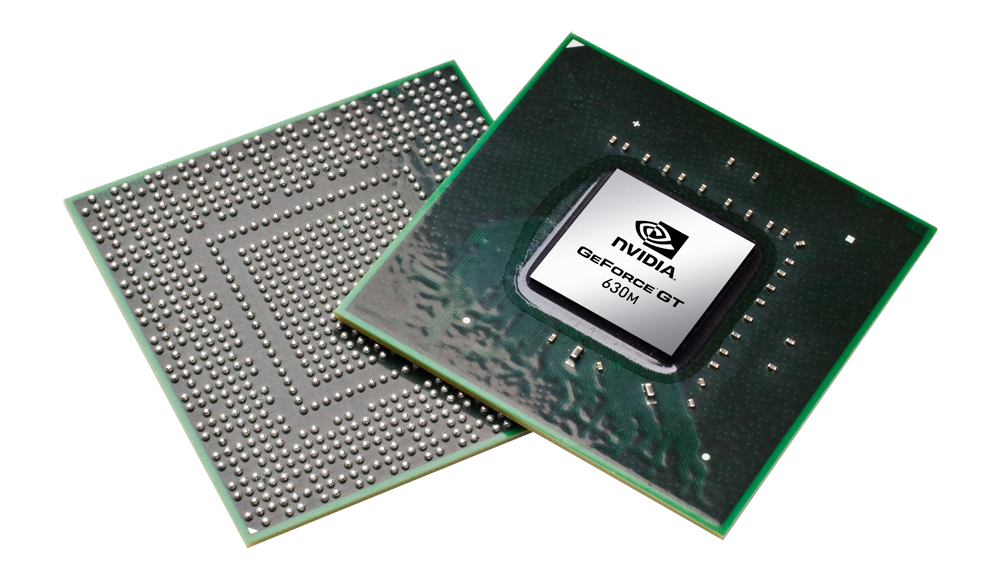
Nvidia Humbly Intros First GeForce 600M graphics cards

Without so much of a stale press release, Nvidia has today introduced its very first GeForce 600M series mobile graphics cards. Unfortunately, there's not much to get excited about as the cards in question, named GeForce GT 635M, GT 630M and 610M, are based on the 40nm GPUs already used by the GeForce 500M line.

We don't want to point any fingers but the fact is the GeForce GT 635M, GT 630M and 610M strike an undeniable resemblance to the GeForce GT 555M/550M, GT 540M and GT 520M, respectively. No worries, AMD has done something similar with the first few cards in the Radeon HD 7000M series.


The GeForce GT 635M comes in two versions, one with 144 CUDA Cores (clocked at 1350 MHz) and a 192-bit memory interface and another with 96 Cores (@ 1506 MHz) and a 128-bit interface , while the GT 630M has 96 Cores (set to 1344 MHz) and a 128-bit interface, whereas the GeForce 610M settles for 48 Cores (@ up to 1800 MHz) and a 64-bit interface.


All three cards are 3D Vision ready and feature support for DirectX 11, OpenGL 4.1, CUDA, PhysX, Optimus, OpenCL, and HDMI 1.4. Laptops equipped with these 'new' GeForce models are expected in 2012.

Monday, November 14, 2011

NVIDIA Reports Financial Results for Third Quarter Fiscal Year 2012

NVIDIA (NASDAQ: NVDA) reported revenue of $1.07 billion for the third quarter of fiscal 2012 ended Oct. 30, 2011, up 4.9 percent from the prior quarter, and up 26.3 percent from $843.9 million in the same period a year earlier.

On a GAAP basis, the company recorded net income of $178.3 million, or $0.29 per diluted share, for the third quarter of fiscal 2012. That compares with net income of $151.6 million, or $0.25 per diluted share, in the prior quarter and $84.9 million, or $0.15 per diluted share, in the same period a year earlier.

On a non-GAAP basis -- which excludes stock-based compensation, amortization of acquisition-related intangible assets, other acquisition related costs, and the tax impact associated with these items -- net income was $217.0 million, or $0.35 per diluted share. That compares with net income of $193.5 million, or $0.32 per diluted share, in the prior quarter, and net income of $117.4 million, $0.20 per share, in the same period a year earlier.

GAAP gross margin was 52.2 percent, a fifth consecutive record, compared with 51.7 percent in the previous quarter and 46.5 percent in the same period a year earlier. Non-GAAP gross margin, at 52.5 percent, was also a record, and compares with 51.9 percent in the prior quarter and 46.8 percent in the same period a year earlier.

"NVIDIA's strategy is coming into its own, as the world becomes increasingly visual and mobile," said Jen-Hsun Huang, president and chief executive of NVIDIA. "Our GPU business accelerated in the third quarter, driven by strong demand from gamers and the professional market. And our mobile business benefited from new devices coming onto the market. With Tegra 3 phone wins well ahead of Tegra 2's pace, we're expecting strong growth in the year ahead."


Outlook
Our outlook for the fourth quarter of fiscal 2012 is as follows:
  • Revenue is expected to be relatively flat, plus or minus two percent, from the third quarter.
  • GAAP and non-GAAP gross margins are expected to be flat to up 0.5 percentage points from the respective GAAP and non-GAAP gross margins in the third quarter.
  • GAAP operating expenses are expected to be approximately $372 million; non-GAAP operating expenses are expected to be approximately $330 million.
  • Our GAAP and non-GAAP tax rates are both expected to be between 14 to 16 percent, excluding any discrete tax events that may occur in the quarter.
We estimate depreciation and amortization for the fourth quarter to be approximately $53 million to $57 million. Capital expenditures are expected to be in the range of $30 to $40 million.

Diluted shares for the fourth quarter are expected to be approximately 618 million.

Third Quarter Fiscal 2012 and Recent Highlights:
  • NVIDIA launched Tegra 3, the world's first quad-core processor for super phones and tablets, bringing PC-class performance levels to tablets and phones. Simultaneously, Asus announced that its Eee Pad Transformer Prime, the first device based on Tegra 3, will be available worldwide in December.
  • In addition, NVIDIA and its partners added three more Tegra-based superphones to the eight already available -- LG Optimus EX, LG Optimus BQ and Motorola Electrify. They also added 13 new tablets, bringing the total to 23. New models include the Asus Slider, Sony Tablet S, Sony Tablet P, Toshiba Scorpio 7", Acer Iconia A100, Sharp Galapagos E-Reader, Dell Streak 10, Lenovo ThinkPad, and Samsung's Galaxy Tab 8.9.
  • NVIDIA Tesla processors were chosen by Oak Ridge National Laboratory, which will deploy 18,000 of them in its new machine, "Titan," expected to be the world's fastest supercomputer, with the potential to deliver speeds of over 20 petaflops.
CFO Commentary
Commentary on the quarter by Karen Burns, NVIDIA interim chief financial officer, is available here.

Friday, November 11, 2011

Nvidia GeForce GTX 560 Ti 448 Cores Details

NVIDIA will launch its newest graphics card SKU, the GeForce GTX 560 Ti 448 Cores. Today we present to you all the specifications that matter: clock speeds, voltages, device IDs, etc., but first a brief history. NVIDIA launched the original GeForce GTX 560 Ti back in January, based on its spanking new GF114 silicon. It packed 384 CUDA cores, a 256-bit wide GDDR5 memory interface, 1 GB of memory, high clock speeds, and fairly decent overclocking potential. AMD's Radeon HD 6870 was "pwned" (NVIDIA's words). But then, AMD managed to work closely with its partners to create a 1 GB version of its Radeon HD 6950 graphics card. Coupled with diligent component cost balancing, AMD was able to neuter GTX 560 Ti to a good extant. With the upcoming winter shopping season, NVIDIA does not want to take any chances with its competitiveness in the $250-ish "sweetspot" segment, and hence it had to redesign the GTX 560 Ti.

The new GeForce GTX 560 Ti will come with "448 Cores" brand extension, and as it suggests, the GPU now has 448 CUDA cores as opposed to 384 cores on the original. The new SKU will use the same silicon on which the GTX 570, GTX 580, and dual-GPU GTX 590 are based: GF110. The chip will carry the marking "GF110-270-A1". Apart from the 448 CUDA cores, the new SKU will have a memory bus width of 320-bit, and standard memory amount of 1280 MB, just like the GTX 570. The GTX 560 Ti Core 448 has clock speeds of 732 MHz core, 1464 MHz CUDA cores or shaders, and 950 MHz actual (1900 MHz DDR, or 3.80 GHz GDDR5 effective) memory clock speed. So the only thing that sets the new GTX 560 Ti 448 Cores from GTX 570 is the CUDA core count (448 vs. 480 on the GTX 570).


Moving on to core voltage NVVDD, the GTX 560 Ti 448 Cores has a similar range to the GTX 570, that's 0.950V to 1.100V ± 1%. The card will draw power from two 6-pin connectors. It's not likely that there will be a NVIDIA-reference board design, but even if there is, it will use a cost-effective cooler, similar to EVGA's GTX 570 HD. As for price, SweClockers suggests that it would be exactly in the middle of the price points GTX 560 Ti 384 cores and GTX 570 occupy.

Source: SweClockers

Tuesday, November 8, 2011

NVIDIA Investigates TDR Issues, Requests Sample Cards

Guru3D reports on a post from NVIDIA tech support on NVIDIA's forums regarding TDR issues (Timeout Detection & Recovery problem (display stopped responding but has successfully recovered)). These problems centre around Battlefield 3 and Windows Media Centre, which NVIDIA can't reproduce, so it looks like the problems may be with specific card models. NVIDIA rep ManuelG posted:
I want to give everyone a quick update on some of the bugs mentioned in this thread:

1) Battlefield 3 bugs - So far we have been able to reproduce the major Battlefield 3 issues and have marked this as must fix for the upcoming driver in November.

2) Video Playback issue in Windows Media Center/Movie Maker/Media Player - This issue has been fixed and will definitively be included in the next driver release in November

3) R280.xx or later Firefox/IE9 TDR issue - We have ordered some of the retail graphics cards that have been mentioned in these threads to resolve this issue. However it would be of great help to us if anyone who is facing this problem can send us their graphics card to diagnose internally at our Santa Clara office since the cards we have been tested so far do not seem to show the TDR issues end users are reporting in this forum. We can pay for shipping both ways and I can probably get some free game codes to offer you for your time. Please PM if you would be willing to do so. You must be in the USA however since international shipping can complicate things.
Source: Guru3D

Monday, October 17, 2011

NVIDIA Introduces 3D Vision 2 Products

VIDIA today unveiled its second generation of 3D Vision products, designed to immerse gamers and enthusiasts in the ultimate 3D experience for games, movies and photos.

NVIDIA 3D Vision 2, the next generation of NVIDIA's award-winning 3D glasses, features a sleek new design and other features to enhance the immersive experience when playing 3D games, or enjoying 3D movies or photos. Among these is NVIDIA 3D LightBoost, a unique new display technology that dramatically improves the 3D experience by delivering images that are up to twice as bright and colors that are far richer than those provided by other 3D display technologies.

These features give gamers the ultimate 3D platform for this Fall's hot new titles, including Batman: Arkham City, LA Noire and more. In addition, through the 3D Vision Ready ecosystem, NVIDIA is delivering the industry's broadest selection of high-quality 3D content and supported displays.


"Gorgeous, bright, crystal-clear 3D worlds are created by NVIDIA's 3D Vision 2 glasses with 3D LightBoost monitors and notebooks," said Phil Eisler, general manager of 3D Vision at NVIDIA. "NVIDIA's engineering team has made incredible enhancements in 3D on PCs, creating a breathtaking gaming experience that's better than the best Hollywood 3D movie."

"NVIDIA 3D LightBoost technology makes 3D games, movies and photos more stunning and life-like than ever before," said David Wung, senior director of product management of Open Platform Business (OPBG) Group for ASUS Computer International. "With 3D LightBoost and our new full-HD monitors, colors are richer, textures and subtle image details virtually jump off the screen, and the overall quality of the experience is something to behold. We are thrilled to be the first desktop display manufacturer to bring this new level of 3D visual quality to our customers with the ASUS VG278H."

NVIDIA 3D Vision 2 Glasses

NVIDIA 3D Vision 2 glasses were designed specifically for gamers and 3D enthusiasts. They provide deeper immersion in games through lenses that are 20 percent larger than those in first-generation glasses, resulting in a wider viewing area and increased external light blocking. In addition, 3D Vision 2 glasses are made of soft composite materials for a more comfortable fit with gaming headphones.

The glasses, which feature NVIDIA's advanced active-shutter and IR wireless technologies, allow gamers and 3D enthusiasts to access the broadest selection of high-quality 3D content available today, including more than 550 full-HD 1080p 3D games, more than 100 Blu-ray 3D movies and thousands of 3D videos and photos from YouTube and 3DVisionLive.com. In addition, 3D Vision 2 glasses are fully backwards-compatible with all existing 3D Vision Ready content and supporting products, including more than 70 different 3D Vision monitors, notebooks and projectors, video applications, and cameras.

NVIDIA 3D LightBoost Technology

3D LightBoost is a new NVIDIA display technology that delivers up to 2X brighter 3D images than existing 3D solutions and improved color quality. It also dramatically increases environmental lighting, making gaming keyboards and mice more visible, and reducing 3D ghosting.

The first 3D LightBoost-certified desktop display is the ASUS VG278H, a 27-inch LED full HD (1920x1080) monitor, featuring a 3D HDMI 1.4 input, as well as a Dual-link DVI input for full HD 1080p 3D gaming. ASUS' exclusive Trace-Free II Technology features 120Hz refresh rates and 2ms response times, resulting in vivid, ultra-smooth visuals. Expected to be available beginning in October 2011, the ASUS VG278H includes 3D Vision 2 glasses and is priced at $699 (USD MSRP).

Additional 3D LightBoost-compatible displays from Acer and BenQ, are expected to ship in the coming months. 3D LightBoost compatible notebooks include several Toshiba models – Satellite P770/P775, Dynabook Satellite T572, Dynabook T572, and the Qosmio X770/X775 – with others expected in the coming months.

3D Vision 2 Pricing and Availability

The 3D Vision 2 glasses kit, which includes one pair of 3D Vision 2 glasses and a wireless USB IR emitter will be available from the leading retailers/e-tailers worldwide in October for $149 (USD MSRP). It will also be available on the NVIDIA online store. Extra 3D Vision 2 glasses are available for $99 (USD MSRP). Visit www.nvidia.com/3dvision for more information.

Source
Tuesday, August 9, 2011

NVIDIA GeForce 280.26 WHQL Software Suite Released

NVIDIA today released this month's first major GeForce software update, version 280.26. The suite provides the latest WHQL-signed drivers for all NVIDIA GeForce GPUs since 6-series, and ION platform. It includes updated PhysX system software (v9.10.0514), and NVIDIA HDMI audio drivers (v1.2.23.3). The new drivers include support for SLI on AMD 990FX, 990X, and 970 desktop chipsets (on certified motherboards only). Apart from that, the 3D Vision component has undergone a massive overhaul.

The 3D Vision Controller driver is now included with all GPU driver installations. The 3D Vision player now supports windowed mode. Support is added for new 3D Vision compatible monitors, such as ViewSonic V3D245, and 3D Vision compatble projectors such as Acer X1111, BenQ W710ST, and NEC NP-V300W.

DOWNLOAD: NVIDIA GeForce 280.26 WHQL for Windows 7/Vista 64-bit | Windows 7/Vista 32-bit | Windows XP 32-bit | Windows XP 64-bit

New 3D Vision profiles are added for a number of game titles, namely, Alice: Madness Returns, Back to the Future (Episodes 1-5), Call of Juarez: The Cartel, Chuang Shi Xi You, Dao Jian 2, The Darkness 2, Dead Island, Deep Black, Dou Zhan Shen, Dragon Ball Online, Dungeons and Dragons: Online, Gods & Heroes: Rome Rising, Harry Potter and the Deathly Hallows Part 1, L.A. Noire, League of Legends, LEGO Pirates of the Caribbean, Lord of the Rings Online: Shadows of Angmar, The Lord of the Rings: War in the North, Mars, Might & Magic Heroes VI, Mount & Blade: Warband, Mount & Blade: With Fire and Blade, PROUN, RAGE, Red Orchestra 2: Heroes of Stalingrad, Rise of the Immortals, Rusty Hearts, Serious Sam 3: BFE, Virtua Tennis 4, and Warhammer 40,000: Space Marine.

3D Vision profiles were updated for Crysis 2, Deep Black and Super Street Fighter IV: Arcade Edition.

Monday, January 31, 2011

Nvidia Developing Subpixel Reconstruction Antialiasing to Fight with MLAA

NVIDIA is developing its own antialiasing (AA) technology to rival morphological antialiasing (MLAA). The subpixel reconstruction antialiasing (SRAA) NVIDIA is currently conducting research on aims to provide better image quality with minimal performance penalty. It "combines single-pixel (1x) shading with subpixel visibility to create antialiased images without increasing the shading cost," as NVIDIA puts it in its research abstract. SRAA is suited for rendering engines that don't use multisample antialiasing (MSAA) since they use deferred shading. For such renderers, SRAA works as a post-processing layer, just like MLAA.

Where SRAA defers from MLAA is that the new algorithm can better respect geometric boundaries and has a fixed runtime independent of scene and image complexity. SRAA benefits shading-bound applications. "For example, our implementation evaluates SRAA in 1.8 ms (1280x720) to yield antialiasing quality comparable to 4-16x shading. Thus SRAA would produce a net speedup over supersampling for applications that spend 1 ms or more on shading; for comparison, most modern games spend 5-10 ms shading. We also describe simplifications that increase performance by reducing quality," claims NVIDIA.

Source: NVIDIA Research

Tuesday, January 11, 2011

Intel to Pay Nvidia Technology Licensing Fee of $1.5 Billion

NVIDIA announced today that it has signed a new six-year cross-licensing agreement with Intel. For the future use of NVIDIA's technology, Intel will pay NVIDIA an aggregate of $1.5 billion in licensing fees payable in five annual installments, beginning Jan. 18, 2011. NVIDIA and Intel have also agreed to drop all outstanding legal disputes between them.

"This agreement signals a new era for NVIDIA," said Jen-Hsun Huang, NVIDIA's president and chief executive officer. "Our cross license with Intel reflects the substantial value of our visual and parallel computing technologies. It also underscores the importance of our inventions to the future of personal computing, as well as the expanding markets for mobile and cloud computing."

Under the new agreement, Intel will have continued access to NVIDIA's full range of patents. In return, NVIDIA will receive an aggregate of $1.5 billion in licensing fees, to be paid in annual installments, and retain use of Intel's patents, consistent with its existing six-year agreement with Intel. This excludes Intel's proprietary processors, flash memory and certain chipsets for the Intel platform.

The existing agreement is to expire March 31, 2011.

Pursuant to U.S. GAAP, a portion of the proceeds will be accounted for and attributed to the settlement of prior legal claims. This amount, which NVIDIA anticipates to be less than $100 million, will be included in the company's fourth-quarter results.

The balance of the licensing fees will be accounted for on a straight-line basis over the six-year term of the agreement. Accordingly it is anticipated that this would amount annually to approximately $233 million of operating income and an increase in net income of $0.29 per diluted share, on a full year basis.

Source