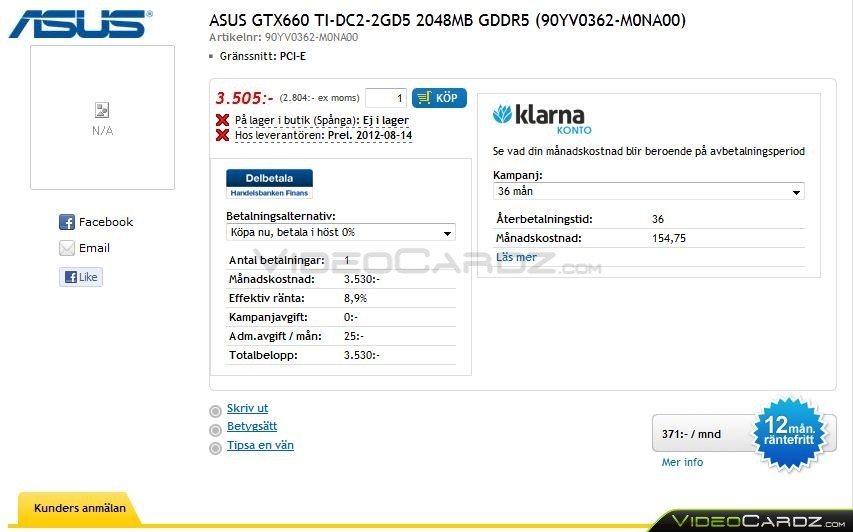
Several Swedish online retailers have begun listing ASUS GeForce GTX 660
Ti DirectCU II graphics card ahead of its worldwide launch. The card is
listed at roughly 3,350 to 3,551 Swedish Kronor (US $492 to $521),
including local taxes. The lowest price before taxes is 2,679 Kronor
($393.5). Looking at these prices, we expect US pricing to be in the
$380-$420 range, before taxes. None of the retailers detailed the card,
let alone post pictures of it. Based on the 28 nm GK104 silicon, the
GeForce GTX 660 Ti is expected to feature 1,344 CUDA cores, and 2 GB of
memory across a 192-bit wide GDDR5 memory interface.
Source: VideoCardz
Showing posts with label Asus. Show all posts
Sunday, August 5, 2012
Friday, February 24, 2012
ASUS Z9PE-D8-WS Motherboard Up For Pre-Order
ASUS' dual-LGA2011 workstation motherboard, the Z9PE-D8-WS, has been listed
by Canadian retailer NCIX for pre-order. It is priced at CA $632.98 (US
$634.56). The store page does not go on to mention availability, except
that orders will be shipped whenever there are inventories. Given its
pre-order listing, we expect the product-launch of the Z9PE-D8-WS not to
be too far, considering Intel's launch of a large number of "Sandy
Bridge-EP" Xeon processors is just around the corner
(within Q1, 2012). The Z9PE-D8-WS is designed to support 2P
configurations based on Xeon "Sandy Bridge-EP" processors. The
motherboard is further detailed here. To PC enthusiasts, it presents a potential alternative to EVGA's SR-X.
Image Courtesy: VR-Zone
Wednesday, February 15, 2012
ASUS Launches HD 7770 DirectCu and Non-Reference HD 7750
ASUS launched its Radeon HD 7700 series with two cards, both
non-reference design, which take advantage of proven cooler designs ASUS
used in previously-launched models. The Radeon HD 7770 card is based on
its DirectCU cooler that has been used on a number of upper-mid range
graphics cards. Its cooler consists of a heat-pipe fed aluminum fin
array, in which the heat-pipes make direct contact with the GPU die.
This card bears slightly overclocked speeds, with the core clocked at
1020 MHz (vs. 1000 MHz reference), and 1150 MHz / 4.60 GHz memory (vs.
1125 / 4.50 GHz reference) memory.
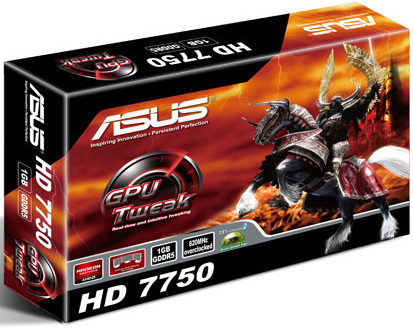
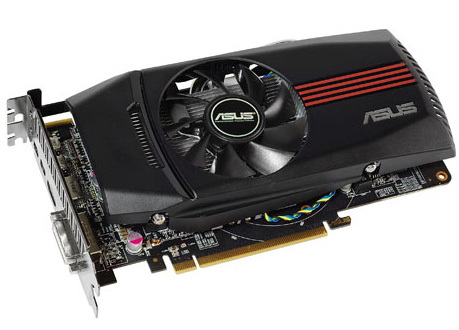
The Radeon HD 7750 card from ASUS uses a non-reference PCB and a cooler design which has been implemented on several mid-range graphics cards by the company in the past it is a fan-heatsink with spirally-projecting aluminum fins, with a copper core at the center. The heatsink is ventilated by a large fan, which is known to be very quiet. Like its bigger brother, this card too features slightly overclocked speeds, with the core clocked at 820 MHz (vs. 800 MHz reference), and 1150 MHz / 4.60 GHz memory (vs. 1125 / 4.50 GHz reference) memory. Expect these cards to stick to common prices of US $159 for the HD 7770 and $109 for the HD 7750.
Source
The Radeon HD 7750 card from ASUS uses a non-reference PCB and a cooler design which has been implemented on several mid-range graphics cards by the company in the past it is a fan-heatsink with spirally-projecting aluminum fins, with a copper core at the center. The heatsink is ventilated by a large fan, which is known to be very quiet. Like its bigger brother, this card too features slightly overclocked speeds, with the core clocked at 820 MHz (vs. 800 MHz reference), and 1150 MHz / 4.60 GHz memory (vs. 1125 / 4.50 GHz reference) memory. Expect these cards to stick to common prices of US $159 for the HD 7770 and $109 for the HD 7750.
Source
Friday, February 10, 2012
ASUS Introduces the O!Play TV Pro Smart TV Set Top Box
The ASUS O!Play TV Pro upgrades living room TV viewing to a completely
digital HD and live experience, enabling easy content consumption and
distribution. Features open up playback and recording of digital
programs, as well as almost any multimedia file currently available with
over 50 formats supported, including 3D. Exclusive O!Easy technology
adds specific one-click functions that cover file streaming, sharing,
and replay, while an always-on design affords direct access to many
major online entertainment and content services, all from a single
user-friendly device.
Playback and recording of digital TV
The O!Play TV Pro comes with a built in DVB-T digital tuner for immediate access to free-to-air high quality digital TV programming. Consumers can readily plan ahead with the Electronic Program Guide (EPG), which offers location-sensitive scheduling for up to a week in advance. Plus, content can be recorded onto an internal 3.5" hard drive using the included Personal Video Recorder (PVR). ASUS has integrated TimeShift into the device, which can pause and resume digital broadcasts in real time should consumers need to get away from the screen, but wish to avoid missing out on their favorite shows.
Support for over 50 formats - including 3D media
Compatibility remains critical for media players, and so the O!Play TV Pro offers seamless use of over 50 major multimedia standards for a worry-free user experience. These include ISO, MKV, RM/RMBV, MVA, AVI, MPEG1/2/4, and MP4. Adding 3D support, the set top box uses H.264 MV (TS, M2TS, and BD-ISO), extending compatibility to cover the most current 3D formatting on the market.
Exclusive ASUS O!Easy technology renders more enjoyable HD multimedia
Playing, streaming, and sharing HD content have been made much easier thanks to the inclusion of O!Easy technology, which connects the O!Play TV Pro to other devices and home networks intuitively. The suite includes multiple one-click functions:
- O!Capture: media and TV program sharing on Facebook
- O!Replay: replay a program’s most recent seven seconds
- O!Direct: streaming content from desktop or notebook PC to TV
- O!MediaShare: wireless streaming of content from mobile devices to TV
- AutoPlay: plug and play videos stored on USB drives or SD/MMC/MS/xD cards without additional setup or installation
Access diverse online entertainment
The O!Play TV Pro offers consumers a totally live product, with constant connectivity over Gigabit Ethernet and Wi-Fi to a wealth of online-based content and services. The device maximizes bandwidth availability to reduce lag and latency for faster downloads and buffer-free streaming. Acetrax, Facebook, YouTube Leanback, DailyMotion, Flickr, and Picasa all come pre-configured for instant access. ASUS offers regular device and service updates, so consumers can expect the range of online content to continue to grow.
Source
Playback and recording of digital TV
The O!Play TV Pro comes with a built in DVB-T digital tuner for immediate access to free-to-air high quality digital TV programming. Consumers can readily plan ahead with the Electronic Program Guide (EPG), which offers location-sensitive scheduling for up to a week in advance. Plus, content can be recorded onto an internal 3.5" hard drive using the included Personal Video Recorder (PVR). ASUS has integrated TimeShift into the device, which can pause and resume digital broadcasts in real time should consumers need to get away from the screen, but wish to avoid missing out on their favorite shows.
Support for over 50 formats - including 3D media
Compatibility remains critical for media players, and so the O!Play TV Pro offers seamless use of over 50 major multimedia standards for a worry-free user experience. These include ISO, MKV, RM/RMBV, MVA, AVI, MPEG1/2/4, and MP4. Adding 3D support, the set top box uses H.264 MV (TS, M2TS, and BD-ISO), extending compatibility to cover the most current 3D formatting on the market.
Exclusive ASUS O!Easy technology renders more enjoyable HD multimedia
Playing, streaming, and sharing HD content have been made much easier thanks to the inclusion of O!Easy technology, which connects the O!Play TV Pro to other devices and home networks intuitively. The suite includes multiple one-click functions:
- O!Capture: media and TV program sharing on Facebook
- O!Replay: replay a program’s most recent seven seconds
- O!Direct: streaming content from desktop or notebook PC to TV
- O!MediaShare: wireless streaming of content from mobile devices to TV
- AutoPlay: plug and play videos stored on USB drives or SD/MMC/MS/xD cards without additional setup or installation
Access diverse online entertainment
The O!Play TV Pro offers consumers a totally live product, with constant connectivity over Gigabit Ethernet and Wi-Fi to a wealth of online-based content and services. The device maximizes bandwidth availability to reduce lag and latency for faster downloads and buffer-free streaming. Acetrax, Facebook, YouTube Leanback, DailyMotion, Flickr, and Picasa all come pre-configured for instant access. ASUS offers regular device and service updates, so consumers can expect the range of online content to continue to grow.
Source
Tuesday, January 31, 2012
ASUS Launches Trio of Radeon HD 7950 Graphics Cards
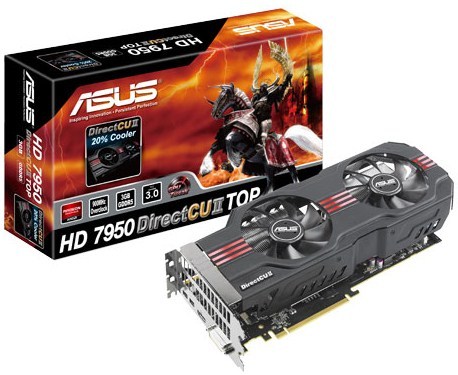
ASUS kicked off its Radeon HD 7950 graphics card lineup with three
models, the HD7950-3GD5 which sticks to the cost-effective AMD reference
design; the HD7950-DC2-3GD5, which is a DirectCu II model that sticks
to AMD reference clock-speeds; and the HD7950-DC2T-3GD5, which is a
DirectCu II TOP model, which features factory-overclocked speeds of 900
MHz core with 1250 MHz memory, while the other two models feature 800
MHz core with 1250 MHz memory.
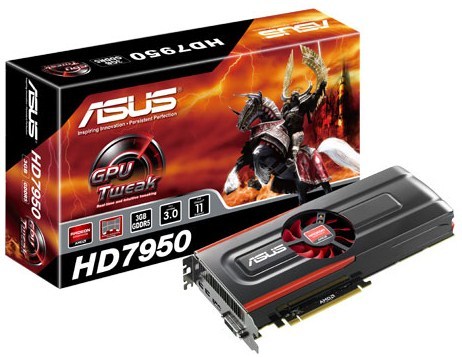
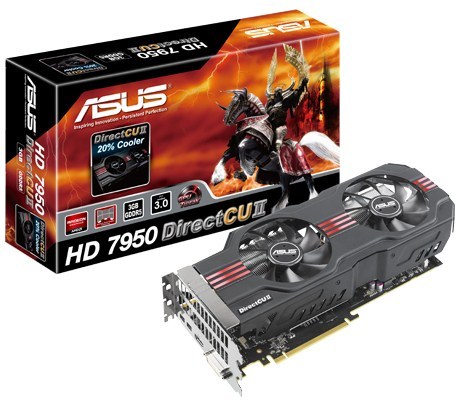
The HD7950-3GD5, which likely sells for US $449, is based on AMD's cost-effective central-fan reference design. The HD7950-DC2-3GD5 uses the company's triple-slot DirectCu II cooler, which is also featured on the Radeon HD 7970 DirectCu II, and is known to provide excellent cooling with low noise, though at the expense of its size. This card will likely be $15-20 costlier. Lastly there's the HD7950-DC2T-3GD5, which likely charges a further $20 premium for its factory overclocked speeds, taking its price close to $490.
Source
The HD7950-3GD5, which likely sells for US $449, is based on AMD's cost-effective central-fan reference design. The HD7950-DC2-3GD5 uses the company's triple-slot DirectCu II cooler, which is also featured on the Radeon HD 7970 DirectCu II, and is known to provide excellent cooling with low noise, though at the expense of its size. This card will likely be $15-20 costlier. Lastly there's the HD7950-DC2T-3GD5, which likely charges a further $20 premium for its factory overclocked speeds, taking its price close to $490.
Source
Friday, January 20, 2012
ASUS Radeon HD 7970 DirectCu II Graphics Card Pictured
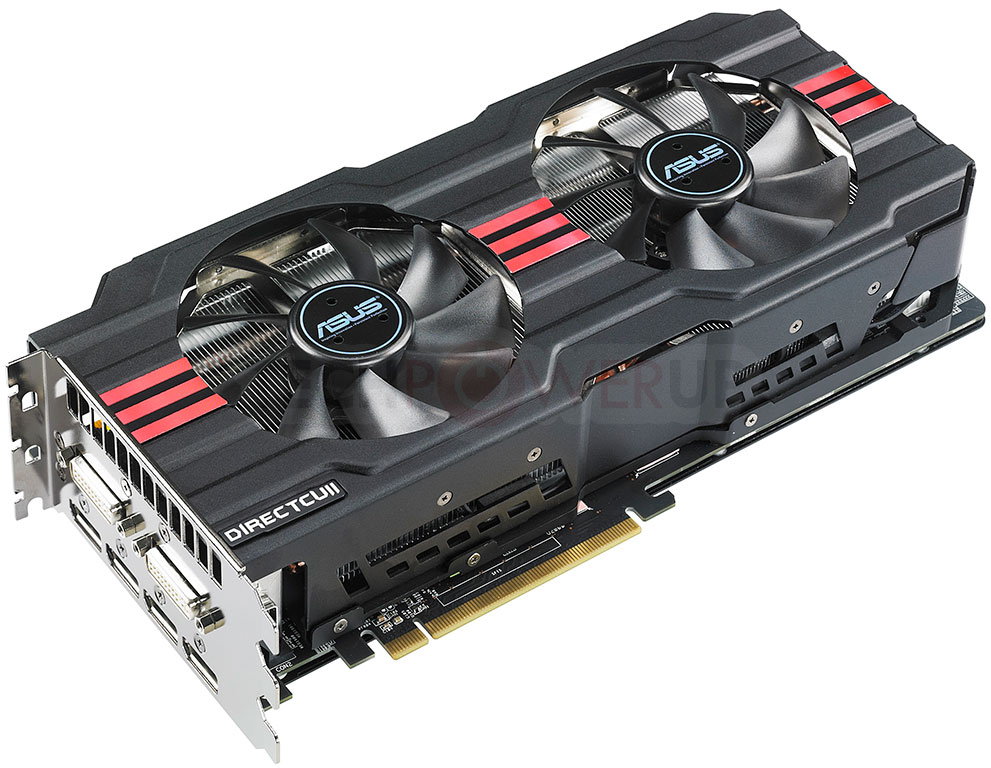
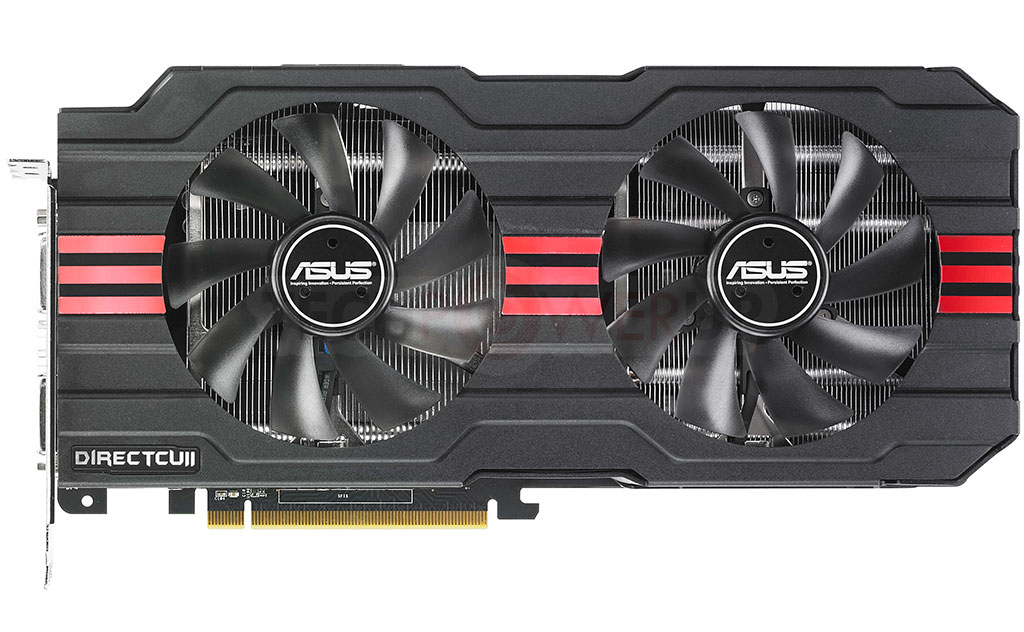
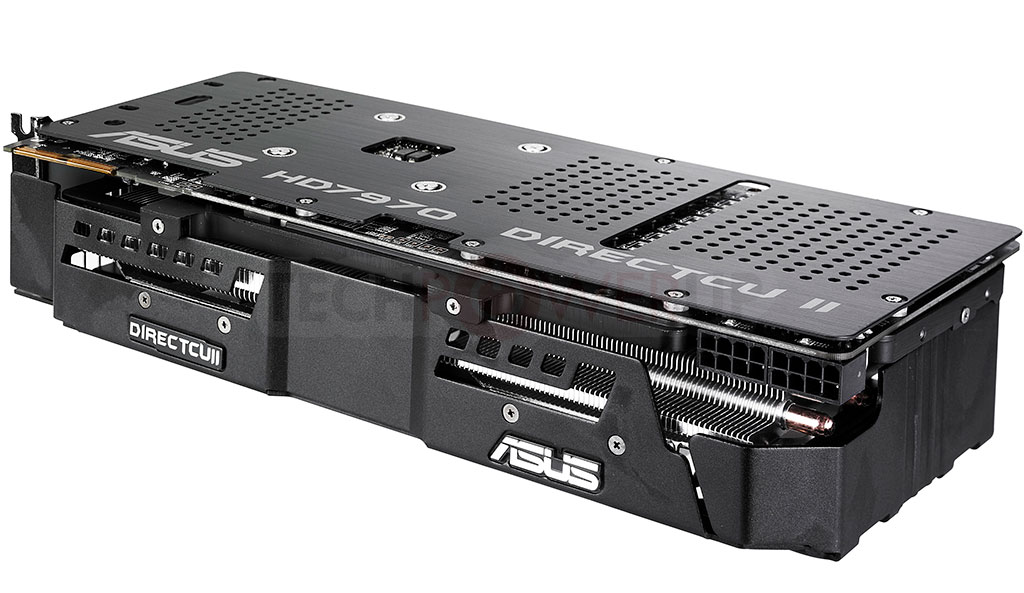
Here are the first pictures of ASUS' premium DirectCu II graphics card
designed around AMD's Radeon HD 7970 GPU. The design is based on giving
the GPU a powerful cooling solution, backed by a custom-design PCB.
Since its cooling solution spans across three expansion slots, one of
the three expansion slot brackets is productively used to provide
additional display connectivity. To begin with, the PCB uses a 10+1+1
ASUS Digi+ VRM that draws power from two 8-pin PCIe power connectors. It
supports heavy overclocking, and provides several voltage tuning
features.
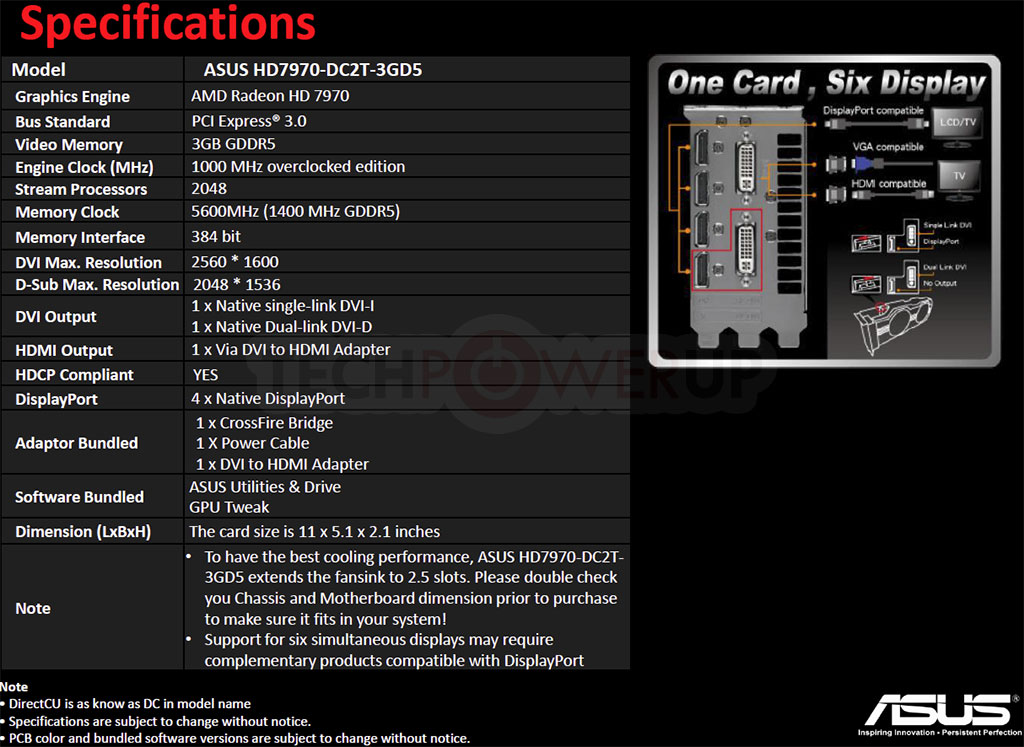
A common metal heatsink spans along the length of the card, making contact with VRM and memory components. On top of this sits the DirectCu II heatsink. This heatsink uses a large aluminum fin-stack heatsink to which heat from the GPU is conveyed by six heat-pipes, which make direct contact with it. The heatsink itself isn't very thick, but what makes the card span across three slots are its two 100 mm fans. The GPU is clocked out of the box at 1000 MHz (vs. 925 MHz reference), and 5.60 GHz/1400 MHz actual memory (vs. 5.50 GHz/1375 MHz actual reference).
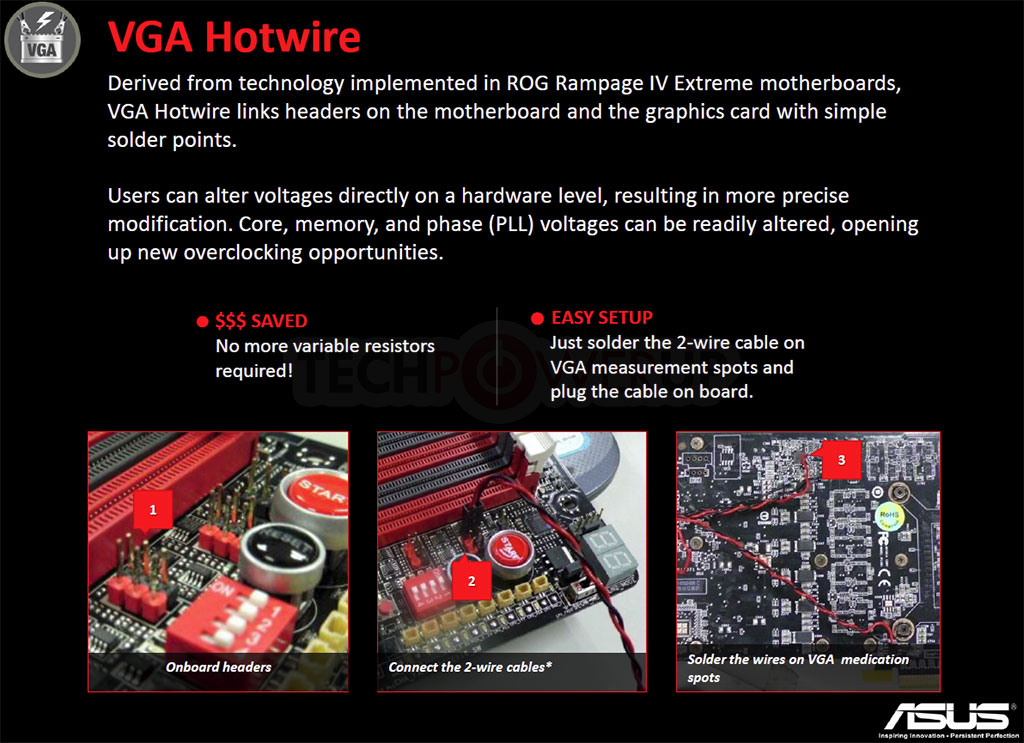
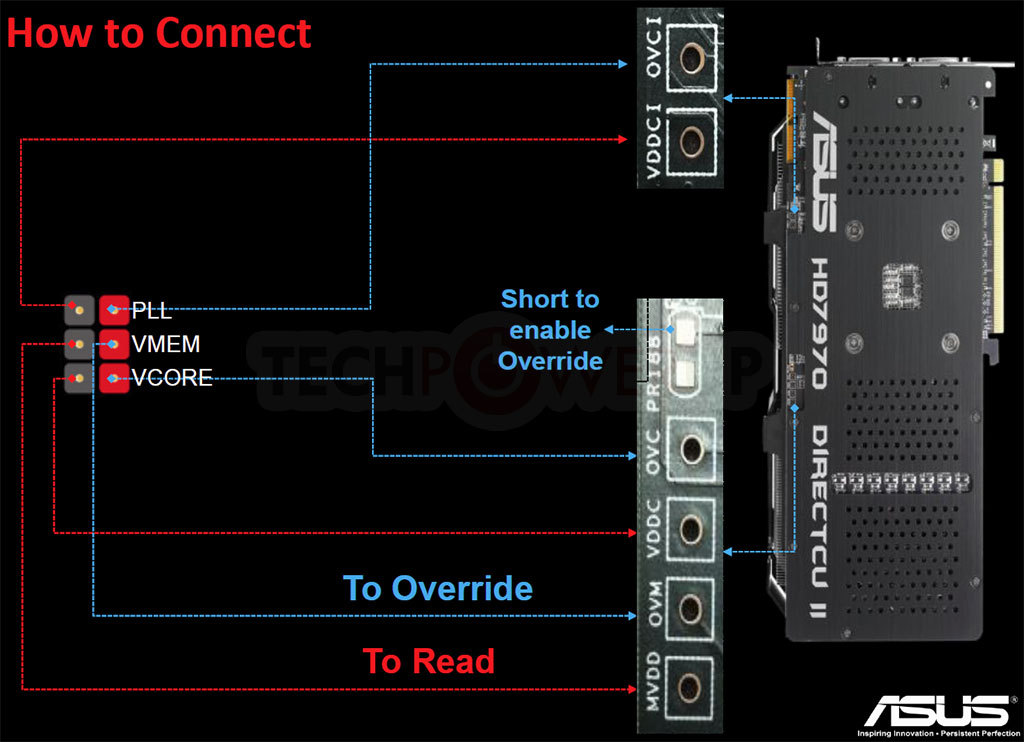
This card also features what is called "VGA Hotwire", which is a 2-pin cable, one end of which needs to be soldered onto the graphics card, the other is plugged into a special header on ROG Rampage IV series motherboards. This allows advanced users to eliminate the need for variable resistors and use the motherboard's voltage controller to tune come key voltage domains of the graphics card as if it were the motherboard's.
Display outputs include two dual-link DVI and four full-size DisplayPort 1.2 connectors. The card is 11 inches (27.94 cm) long, and we mentioned earlier spans across three expansion slots in your case. ASUS' previous-generation DirectCu II cards based on GeForce GTX 580/570 and Radeon HD 6970/6950 were just as big. Pricing information is not available.
Source
A common metal heatsink spans along the length of the card, making contact with VRM and memory components. On top of this sits the DirectCu II heatsink. This heatsink uses a large aluminum fin-stack heatsink to which heat from the GPU is conveyed by six heat-pipes, which make direct contact with it. The heatsink itself isn't very thick, but what makes the card span across three slots are its two 100 mm fans. The GPU is clocked out of the box at 1000 MHz (vs. 925 MHz reference), and 5.60 GHz/1400 MHz actual memory (vs. 5.50 GHz/1375 MHz actual reference).
This card also features what is called "VGA Hotwire", which is a 2-pin cable, one end of which needs to be soldered onto the graphics card, the other is plugged into a special header on ROG Rampage IV series motherboards. This allows advanced users to eliminate the need for variable resistors and use the motherboard's voltage controller to tune come key voltage domains of the graphics card as if it were the motherboard's.
Display outputs include two dual-link DVI and four full-size DisplayPort 1.2 connectors. The card is 11 inches (27.94 cm) long, and we mentioned earlier spans across three expansion slots in your case. ASUS' previous-generation DirectCu II cards based on GeForce GTX 580/570 and Radeon HD 6970/6950 were just as big. Pricing information is not available.
Source
Tuesday, January 17, 2012
ASUS Launches ROG Rampage IV GENE X79 mATX Gaming Board
Rampage IV GENE continues the legacy of Republic of Gamers motherboards
by delivering gamers with enhanced performance that places a premium on
fidelity and speed. SupremeFX III EMI-shielded audio guarantees better
in-game sound, Intel Ethernet LAN and ROG GameFirst technology boost
online multiplayer performance, while ROG Extreme Engine Digi+ II
digital voltage regulation promotes improved overclocking.
The board further uses Black Metallic capacitors and NexFET Power Block MOSFETs for added durability and heat resistance. Unlike budget micro ATX boards, it supports 2-way NVIDIA SLI and AMD CrossFireX.
SupremeFX III audio
Electromagnetic interference (EMI) remains a detriment to quality sound, causing distortion and loss unless properly mitigated. Rampage IV GENE uses a custom PCB "red line" layout which physically isolates SupremeFX III hardware from the rest of the motherboard to eliminate interference and generate clearer, more precise, and deeper audio. Better sound helps competitive gamers with improved positioning and spatial awareness, in addition to promoting greater immersion. SupremeFX III comes with its own steel shield, a 1500uF capacitor for stable audio power delivery, plus gold-plated audio jacks. The setup has been tested to 110 dB SNR, ensuring lossless performance. EAX Advanced HD 5.0, Creative Alchemy, and THX TruStudio PRO are all fully supported. Rampage IV GENE comes bundled with a Creative Sound Blaster X-Fi MB2 suite, providing the finest game audio of any micro ATX board, with realistic sound effect reproduction, lifelike music, and theater-grade movie sound.
Lag-resistant online gaming and multi-GPU support
Intel Ethernet reduces CPU utilization by as much as 35% when processing online activity compared to systems using standard LAN, which combats latency and boosts packet transmission. Better network performance presents an edge for gamers, with the overwhelming importance of global online multiplayer gaming requiring faster connections for a smooth and competitive experience. ROG-exclusive GameFirst contributes to achieving this goal, working as a connection supervisor to prioritize bandwidth availability and ensure games receive sufficient resources, even when downloading occurs in the background. To further accommodate gamers, Rampage IV GENE supports PCI Express 3.0 and 2-way SLI/CrossFireX for increased future proofing and flexibility.
Greater overclocking through improved endurance and stability
Rampage IV GENE ships with the exclusive ROG Extreme Engine Digi+ II design, consisting of digital voltage regulators for refined tuning and higher power efficiency. Gamers can adjust voltages in more precise increments, which aids in overclocking. Supporting this, Black Metallic capacitors and NexFET Power Block MOSFETs easily surpass the capabilities of generic parts. They resist heat better, last up to five times longer, and can take up to 20% higher temperatures than generic components, culminating in a highly durable and long lasting board that reduces the likelihood of instability even when running high intensity applications.
First X79 board officially certified by the USB-IF
In addition to its many advantages, the Rampage IV GENE has also secured the honor of being the first Intel X79-based motherboard formally authorized and certified USB 3.0-ready by the USB Implementers Forum. Certification speaks of the extensive testing and compatibility assurance ASUS puts into every board from early development to shipping. Always committed to advancing technology and giving consumers the best performance possible, ASUS has gone further and self-developed USB 3.0 Boost to accelerate data speeds beyond reference requirements. The multi-mode design of USB 3.0 Boost increases device connectivity for both the traditional BOT protocol and the newer UASP, and its inclusion on ROG boards offers gamers even better value than before.
Complete range of X79 gaming boards
The release of Rampage IV GENE follows the previous launch of Rampage IV Extreme and Rampage IV Formula Intel Socket LGA 2011/X79 Express Chipset-based models. The three maintain ROG leadership in the gaming and overclocking motherboard segments, providing consumers with superior performance and the finest quality in a vibrant PC gaming scene where technical excellence is critical.
Source
The board further uses Black Metallic capacitors and NexFET Power Block MOSFETs for added durability and heat resistance. Unlike budget micro ATX boards, it supports 2-way NVIDIA SLI and AMD CrossFireX.
SupremeFX III audio
Electromagnetic interference (EMI) remains a detriment to quality sound, causing distortion and loss unless properly mitigated. Rampage IV GENE uses a custom PCB "red line" layout which physically isolates SupremeFX III hardware from the rest of the motherboard to eliminate interference and generate clearer, more precise, and deeper audio. Better sound helps competitive gamers with improved positioning and spatial awareness, in addition to promoting greater immersion. SupremeFX III comes with its own steel shield, a 1500uF capacitor for stable audio power delivery, plus gold-plated audio jacks. The setup has been tested to 110 dB SNR, ensuring lossless performance. EAX Advanced HD 5.0, Creative Alchemy, and THX TruStudio PRO are all fully supported. Rampage IV GENE comes bundled with a Creative Sound Blaster X-Fi MB2 suite, providing the finest game audio of any micro ATX board, with realistic sound effect reproduction, lifelike music, and theater-grade movie sound.
Lag-resistant online gaming and multi-GPU support
Intel Ethernet reduces CPU utilization by as much as 35% when processing online activity compared to systems using standard LAN, which combats latency and boosts packet transmission. Better network performance presents an edge for gamers, with the overwhelming importance of global online multiplayer gaming requiring faster connections for a smooth and competitive experience. ROG-exclusive GameFirst contributes to achieving this goal, working as a connection supervisor to prioritize bandwidth availability and ensure games receive sufficient resources, even when downloading occurs in the background. To further accommodate gamers, Rampage IV GENE supports PCI Express 3.0 and 2-way SLI/CrossFireX for increased future proofing and flexibility.
Greater overclocking through improved endurance and stability
Rampage IV GENE ships with the exclusive ROG Extreme Engine Digi+ II design, consisting of digital voltage regulators for refined tuning and higher power efficiency. Gamers can adjust voltages in more precise increments, which aids in overclocking. Supporting this, Black Metallic capacitors and NexFET Power Block MOSFETs easily surpass the capabilities of generic parts. They resist heat better, last up to five times longer, and can take up to 20% higher temperatures than generic components, culminating in a highly durable and long lasting board that reduces the likelihood of instability even when running high intensity applications.
First X79 board officially certified by the USB-IF
In addition to its many advantages, the Rampage IV GENE has also secured the honor of being the first Intel X79-based motherboard formally authorized and certified USB 3.0-ready by the USB Implementers Forum. Certification speaks of the extensive testing and compatibility assurance ASUS puts into every board from early development to shipping. Always committed to advancing technology and giving consumers the best performance possible, ASUS has gone further and self-developed USB 3.0 Boost to accelerate data speeds beyond reference requirements. The multi-mode design of USB 3.0 Boost increases device connectivity for both the traditional BOT protocol and the newer UASP, and its inclusion on ROG boards offers gamers even better value than before.
Complete range of X79 gaming boards
The release of Rampage IV GENE follows the previous launch of Rampage IV Extreme and Rampage IV Formula Intel Socket LGA 2011/X79 Express Chipset-based models. The three maintain ROG leadership in the gaming and overclocking motherboard segments, providing consumers with superior performance and the finest quality in a vibrant PC gaming scene where technical excellence is critical.
Source
Tuesday, January 10, 2012
ASUS ROG Phoebus Sound Card Pictured, Driven by New CMI Oxygen Express Chip
ASUS displayed its latest sound card, the Republic of Gamers (ROG)
Phoebus. This card is designed for multichannel gaming audio. While it
might not pack any fancy DSP that doesn't already exist, its AMP
circuitry is so designed to give the best positional audio that could
come handy with competitive online gaming. With this card, ASUS also
brought to the fore C-Media's latest audio chipset, the CMI 8788DH
Oxygen Express, which packs native PCI Express support. All PCI Express
sound cards launched by ASUS so far feature OxygenHD and ASUS-rebadged
AV-100 chipsets, that use legacy PCI, and hence depend on PCIe-to-PCI
bridge chips by PLX to function on PCI Express.
The primary DAC for headphone/front-out channel of the ROG Phoebus is TI-BB PCM1792A, with stellar signal-noise ratio (SNR) of 127 dBA. Other main channels are handled by Cirrus Logic, probably the CS5381, with SNR of 120 dBA. There's also a tertiary Realtek ALC889 (110 dBA) CODEC that probably handles an independent set of audio channels, or handles the digital outputs, since it's licensed with a few Dolby technologies. On the AMP side, we spy bleeding-edge OPAMPs, a Texas Instruments 6120A2(?) AMP chip (for the headphones channel), etc.
Many parts of the card are electrically isolated from the PCI Express slot, to prevent interference from the ground layer of the motherboard. So these parts rely on power drawn from a 6-pin PCIe power connector, conditioned by a tiny VRM. Only the power-conditioning parts of the card use solid-state capacitors, the AMP and audio parts use audiophile-grade electrolytic capacitors since by design they are better for analogue circuits. The whole card is topped off with a groovy-looking EMI shield. Expect this card to be costly.
Source: VR-Zone
The primary DAC for headphone/front-out channel of the ROG Phoebus is TI-BB PCM1792A, with stellar signal-noise ratio (SNR) of 127 dBA. Other main channels are handled by Cirrus Logic, probably the CS5381, with SNR of 120 dBA. There's also a tertiary Realtek ALC889 (110 dBA) CODEC that probably handles an independent set of audio channels, or handles the digital outputs, since it's licensed with a few Dolby technologies. On the AMP side, we spy bleeding-edge OPAMPs, a Texas Instruments 6120A2(?) AMP chip (for the headphones channel), etc.
Many parts of the card are electrically isolated from the PCI Express slot, to prevent interference from the ground layer of the motherboard. So these parts rely on power drawn from a 6-pin PCIe power connector, conditioned by a tiny VRM. Only the power-conditioning parts of the card use solid-state capacitors, the AMP and audio parts use audiophile-grade electrolytic capacitors since by design they are better for analogue circuits. The whole card is topped off with a groovy-looking EMI shield. Expect this card to be costly.
Source: VR-Zone
ASUS Dual-Socket LGA2011 Motherboard Pictured
At CES, ASUS showed off its latest workstation motherboard designed for
2P socket LGA2011 Sandy Bridge-EP eight-core processors, the Z9PE-D8-WS.
By the looks of it, it might not be having the voltage-delivery muscle
of EVGA's SR3, but it is filled to the brim with connectivity. Each
socket is powered by a 14-phase Digi+ II VRM, there are numerous other
power domains. The board draws power from a 24-pin ATX connector, two
8-pin EPS connectors, and a 4-pin Molex.
The sockets are each wired to four DDR3 DIMM slots, giving this board the ability to hold up to 256 GB of RAM. There are seven PCI-Express 3.0 x16 expansion slots, from which four (blue) are x16 capable, and three (black) x8 capable. There are as many as 10 SATA ports, of which six appear to be 6 Gb/s capable. In terms of connectivity, an ASpeed AST2300 provides basic display and management over IP functions; there are two gigabit Ethernet interfaces driven by Intel-made controllers, two USB 3.0 ports, 8-channel HD audio, and a number of USB 2.0 ports. ASUS demonstrated this board by running two 2P capable unknown processors, three latest NVIDIA Tesla GPU compute cards, and an ASUS-made graphics card. Unlike with EVGA SR3, which is technically a workstation motherboard designed for enthusiasts, the Z9PE-D8-WS is intentioned to be a workstation motherboard only.
Source: VR-Zone
The sockets are each wired to four DDR3 DIMM slots, giving this board the ability to hold up to 256 GB of RAM. There are seven PCI-Express 3.0 x16 expansion slots, from which four (blue) are x16 capable, and three (black) x8 capable. There are as many as 10 SATA ports, of which six appear to be 6 Gb/s capable. In terms of connectivity, an ASpeed AST2300 provides basic display and management over IP functions; there are two gigabit Ethernet interfaces driven by Intel-made controllers, two USB 3.0 ports, 8-channel HD audio, and a number of USB 2.0 ports. ASUS demonstrated this board by running two 2P capable unknown processors, three latest NVIDIA Tesla GPU compute cards, and an ASUS-made graphics card. Unlike with EVGA SR3, which is technically a workstation motherboard designed for enthusiasts, the Z9PE-D8-WS is intentioned to be a workstation motherboard only.
Source: VR-Zone
Thursday, December 8, 2011
ASUS Rampage IV Gene Detailed
Nearly a month after going all guns blazing into the Sandy Bridge-E
LGA2011 market with the Rampage IV Extreme, ASUS is close to launching
its premium Republic of Gamers motherboard in the micro-ATX form-factor,
the ROG Rampage IV Gene. News of this board surfaced
in mid-November along with details of Rampage IV Formula, but with
close to no details, not even a picture to go on. Sweclockers scored an
internal presentation by ASUS that details this new kid on the block.
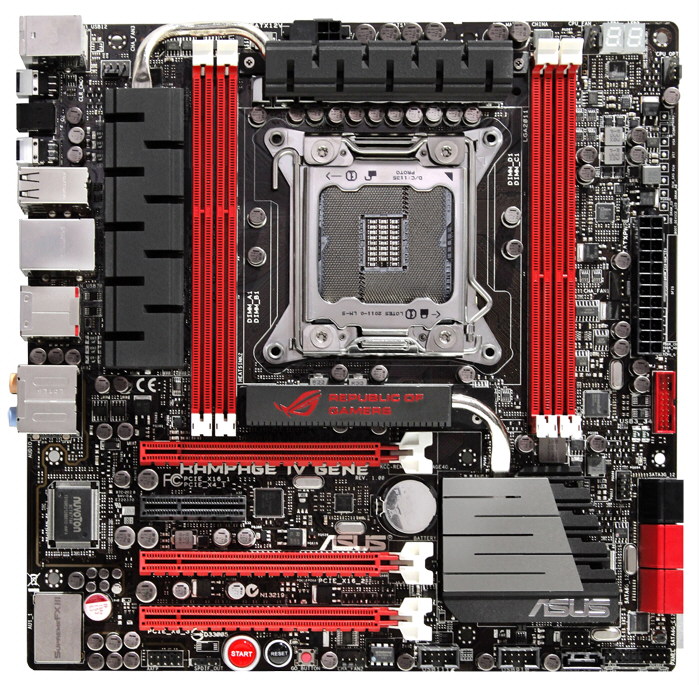
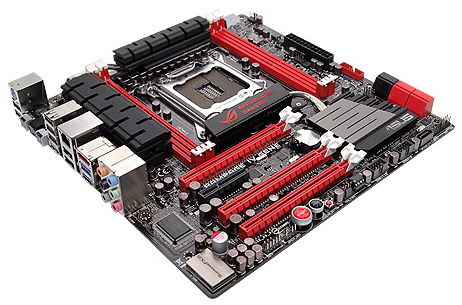
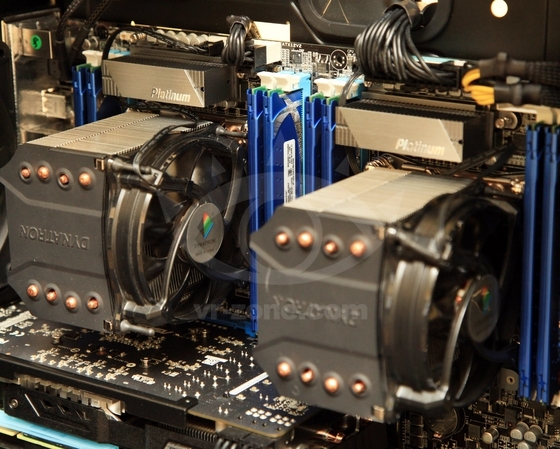
The Rampage IV Gene could very well be the first micro-ATX motherboard that's designed to be 3-way SLI/CrossFire capable, with PCIe slots wired to the system's main root complex. Its top-half layout is similar to that of every other X79 motherboard, with the LGA2011 processor socket sitting between two sets of DDR3 DIMM slots. In this board, each set has just two slots, each with its own 64-bit wide memory path (channel) to the processor IMC. The processor is powered by an 8-phase Digi+ II VRM. The VRM makes use of compact DrMOS chips, that are cooled by two sets of heatsinks connected by a heat pipe.
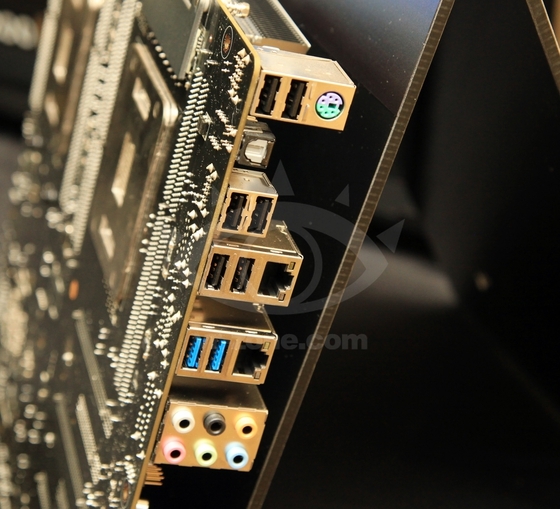
Expansion slots include three PCI-Express 3.0 x16, which are configured as x16/x16/x8, and an open-ended PCI-Express 2.0 x4, wired to the X79 PCH. Storage connectivity includes four SATA 6 Gb/s (red, from which two are wired to the X79 PCH, two to an ASMedia-made third-party controller); and three SATA 3 Gb/s ports (black, all wired to the PCH). The fourth SATA 3 Gb/s port from the PCH is assigned as eSATA. General connectivity includes SupremeFX III 8-channel audio backed by X-Fi MB software, one gigabit Ethernet connection driven by an Intel-made controller, four USB 3.0 ports (from which two are via header), USB 2.0, and PS/2 combo. There are several ASUS ROG-exclusive features, including ROG Connect, ROG GameFirst, USB BIOS Flashback, ASUS UEFI BIOS with ROG-exclusive features. We still don't have a clear release date.
Source: SweClockers
The Rampage IV Gene could very well be the first micro-ATX motherboard that's designed to be 3-way SLI/CrossFire capable, with PCIe slots wired to the system's main root complex. Its top-half layout is similar to that of every other X79 motherboard, with the LGA2011 processor socket sitting between two sets of DDR3 DIMM slots. In this board, each set has just two slots, each with its own 64-bit wide memory path (channel) to the processor IMC. The processor is powered by an 8-phase Digi+ II VRM. The VRM makes use of compact DrMOS chips, that are cooled by two sets of heatsinks connected by a heat pipe.
Expansion slots include three PCI-Express 3.0 x16, which are configured as x16/x16/x8, and an open-ended PCI-Express 2.0 x4, wired to the X79 PCH. Storage connectivity includes four SATA 6 Gb/s (red, from which two are wired to the X79 PCH, two to an ASMedia-made third-party controller); and three SATA 3 Gb/s ports (black, all wired to the PCH). The fourth SATA 3 Gb/s port from the PCH is assigned as eSATA. General connectivity includes SupremeFX III 8-channel audio backed by X-Fi MB software, one gigabit Ethernet connection driven by an Intel-made controller, four USB 3.0 ports (from which two are via header), USB 2.0, and PS/2 combo. There are several ASUS ROG-exclusive features, including ROG Connect, ROG GameFirst, USB BIOS Flashback, ASUS UEFI BIOS with ROG-exclusive features. We still don't have a clear release date.
Source: SweClockers
Tuesday, November 15, 2011
ASUS Launches the Most Complete and Innovative X79 Motherboard Lineup
ASUS, maker of the world’s best-selling and most innovative
motherboards, is excited to release a wide range of new X79
motherboards. All feature the new Intel X79 Express Chipset, with support for 2nd generation Core i7 processors
in the new LGA 2011 Socket. The complete lineup includes P9X79 Series
motherboards with total performance tuning and control, the
enthusiast-centric ROG Rampage IV Extreme, the ultra-reliable TUF
SABERTOOTH X79, and the professional P9X79 WorkStation Series supporting
NVIDIA 4-way SLI and AMD CrossFireX.
All motherboards feature ASUS Dual Intelligent Processor 3 technology with the latest ASUS DIGI+ Power Control design providing three digital voltage controllers onboard, one for the CPU and two for DRAM. ASUS’ class-leading Digital Power designs result in better performance, greater stability, and enhanced overclocking for all users. All of the new motherboards ship with multi-GPU support, PCI Express 3.0 capabilities*, exclusive ASUS UEFI and up to 64GB of quad-channel DDR3 support via 8-DIMM slots.
P9X79 Series: The ideal choice for unmatched features and user-friendly innovation
ASUS has developed the best power, system, and BIOS tuning options available for users to ensure an optimized computing experience on the new P9X79 Deluxe, P9X79 Pro, and P9X79 motherboards. Each feature ASUS’ new DIGI+ Power Control and DIGI+ Memory voltage options that allow users to reach higher processor and DRAM overclocks with the upmost stability and reliability.
An 8-DIMM quad-channel design supports up to 64GB of DDR3 memory that takes full advantage of 64-bit applications. Additional memory capacity assists with intensive data, image, and video processing applications while users can also set up large RAM disks to greatly accelerate system performance. ASUS SSD Caching is extremely user-friendly with one-click speedup functionality that combines solid state drive speeds with mechanical hard drive capacities, providing up to three times faster storage performance.
The ASUS UEFI BIOS has won media and user acclaim for its intuitive and easy GUI interaction. The latest version has been upgraded with the industry first F12 BIOS snapshot hotkey, the F3 system info shortcut, and DRAM SPD (Serial Presence Detect), which offers advanced support for memory troubleshooting. USB BIOS Flashback enables true plug and play UEFI flashing with any USB storage device. It works even without powering up the PC, using only standby power without a CPU, Video card or memory installed. Optional BT GO 3.0! consists of an onboard Bluetooth v3.0 +HS module that offers wireless 802.11n support, adding instant access point detection and setup for Wi-Fi everywhere.
The exclusive ASUS BT suite includes several special functions, allowing users to easily sync and transfer files between PC and mobile devices, and even use smartphones to overclock or monitor their PC. ASUS USB 3.0 Boost adds new UASP support to accelerate USB 3.0 performance by almost three times over standard protocols with supported devices.
ROG Rampage IV Extreme: The best choice for gamers and enthusiasts
The Rampage IV Extreme supports 4-way NVIDIA SLI and AMD CrossFireX and is designed to empower overclockers to reach new records while also offering the absolute best gaming performance and stability. It comes loaded with overclocking features well-suited to competitive benchmarking. Exclusive ROG X-Socket means LGA 1366 based CPU coolers and LN2 containers can be used as-is with the new board. OC Key is an ROG-designed device that connects to the DVI port of any graphics card to display performance and overclocking info on the screen independent of system resources. Users can make changes with no additional software, and without slowing their PC down.
For enhanced and modified cooling, ROG has developed Subzero Sense, which detects cooling system temperatures as low as -193゚C. ROG Extreme Engine Digi+ II and specially sourced high-grade capacitors ensure long lasting and high-endurance power delivery demanded by gamers and competitive overclockers. The Rampage IV Extreme comes bundled with the hit game Battlefield 3 from EA and DICE, which uses the Frostbite 2 engine to showcase the latest in DirectX 11 technology and graphics effects.
TUF SABERTOOTH X79: The reliability choice for rugged engineering and long-life
The new TUF SABERTOOTH X79 ships with an intelligent thermal design, military grade-tested TUF components, and exclusive cooling features for enhanced system stability under the harshest conditions. TUF Thermal Armor with dual fans expands cooling and precise airflow for more effective heat dissipation, improving system reliability and performance. TUF Thermal Radar monitors real-time temps via 12 sensors in strategic locations on the board, automatically adjusting fan speeds to maintain extended stability and prevent overheating. Military-grade TUF components include capacitors, chokes, and MOSFETs. Their heat and stress tolerance allows ASUS to offer an exclusive 5-year warranty on the SABERTOOTH X79. Additionally, the new model includes the new DIGI+ Power Control design and UEFI, giving it the same precision, performance, and user friendly options offered by the P9X79 Series.
P9X79 WS: The ideal professional choice for multi-GPU expandability
Enhanced features and absolute stability is required from professional users and the P9X79 WS delivers, beginning with NVIDIA 4-way SLI and AMD CrossFireX and dual hardware-accelerated Intel LAN ports, which reduces CPU utilization for netcode processing by up to 71%. The P9X79 Work Station supports both Intel Core i7 processors and the upcoming workstation-specific Xeon family, and maintains compatibility with multiple memory, operating system, and RAID card selections. ASUS SSD Caching and USB BIOS Flashback are included along with ASUS’ DIGI+ Power Control design and award winning UEFI.
Source
All motherboards feature ASUS Dual Intelligent Processor 3 technology with the latest ASUS DIGI+ Power Control design providing three digital voltage controllers onboard, one for the CPU and two for DRAM. ASUS’ class-leading Digital Power designs result in better performance, greater stability, and enhanced overclocking for all users. All of the new motherboards ship with multi-GPU support, PCI Express 3.0 capabilities*, exclusive ASUS UEFI and up to 64GB of quad-channel DDR3 support via 8-DIMM slots.
P9X79 Series: The ideal choice for unmatched features and user-friendly innovation
ASUS has developed the best power, system, and BIOS tuning options available for users to ensure an optimized computing experience on the new P9X79 Deluxe, P9X79 Pro, and P9X79 motherboards. Each feature ASUS’ new DIGI+ Power Control and DIGI+ Memory voltage options that allow users to reach higher processor and DRAM overclocks with the upmost stability and reliability.
An 8-DIMM quad-channel design supports up to 64GB of DDR3 memory that takes full advantage of 64-bit applications. Additional memory capacity assists with intensive data, image, and video processing applications while users can also set up large RAM disks to greatly accelerate system performance. ASUS SSD Caching is extremely user-friendly with one-click speedup functionality that combines solid state drive speeds with mechanical hard drive capacities, providing up to three times faster storage performance.
The ASUS UEFI BIOS has won media and user acclaim for its intuitive and easy GUI interaction. The latest version has been upgraded with the industry first F12 BIOS snapshot hotkey, the F3 system info shortcut, and DRAM SPD (Serial Presence Detect), which offers advanced support for memory troubleshooting. USB BIOS Flashback enables true plug and play UEFI flashing with any USB storage device. It works even without powering up the PC, using only standby power without a CPU, Video card or memory installed. Optional BT GO 3.0! consists of an onboard Bluetooth v3.0 +HS module that offers wireless 802.11n support, adding instant access point detection and setup for Wi-Fi everywhere.
The exclusive ASUS BT suite includes several special functions, allowing users to easily sync and transfer files between PC and mobile devices, and even use smartphones to overclock or monitor their PC. ASUS USB 3.0 Boost adds new UASP support to accelerate USB 3.0 performance by almost three times over standard protocols with supported devices.
ROG Rampage IV Extreme: The best choice for gamers and enthusiasts
The Rampage IV Extreme supports 4-way NVIDIA SLI and AMD CrossFireX and is designed to empower overclockers to reach new records while also offering the absolute best gaming performance and stability. It comes loaded with overclocking features well-suited to competitive benchmarking. Exclusive ROG X-Socket means LGA 1366 based CPU coolers and LN2 containers can be used as-is with the new board. OC Key is an ROG-designed device that connects to the DVI port of any graphics card to display performance and overclocking info on the screen independent of system resources. Users can make changes with no additional software, and without slowing their PC down.
For enhanced and modified cooling, ROG has developed Subzero Sense, which detects cooling system temperatures as low as -193゚C. ROG Extreme Engine Digi+ II and specially sourced high-grade capacitors ensure long lasting and high-endurance power delivery demanded by gamers and competitive overclockers. The Rampage IV Extreme comes bundled with the hit game Battlefield 3 from EA and DICE, which uses the Frostbite 2 engine to showcase the latest in DirectX 11 technology and graphics effects.
TUF SABERTOOTH X79: The reliability choice for rugged engineering and long-life
The new TUF SABERTOOTH X79 ships with an intelligent thermal design, military grade-tested TUF components, and exclusive cooling features for enhanced system stability under the harshest conditions. TUF Thermal Armor with dual fans expands cooling and precise airflow for more effective heat dissipation, improving system reliability and performance. TUF Thermal Radar monitors real-time temps via 12 sensors in strategic locations on the board, automatically adjusting fan speeds to maintain extended stability and prevent overheating. Military-grade TUF components include capacitors, chokes, and MOSFETs. Their heat and stress tolerance allows ASUS to offer an exclusive 5-year warranty on the SABERTOOTH X79. Additionally, the new model includes the new DIGI+ Power Control design and UEFI, giving it the same precision, performance, and user friendly options offered by the P9X79 Series.
P9X79 WS: The ideal professional choice for multi-GPU expandability
Enhanced features and absolute stability is required from professional users and the P9X79 WS delivers, beginning with NVIDIA 4-way SLI and AMD CrossFireX and dual hardware-accelerated Intel LAN ports, which reduces CPU utilization for netcode processing by up to 71%. The P9X79 Work Station supports both Intel Core i7 processors and the upcoming workstation-specific Xeon family, and maintains compatibility with multiple memory, operating system, and RAID card selections. ASUS SSD Caching and USB BIOS Flashback are included along with ASUS’ DIGI+ Power Control design and award winning UEFI.
Source
Monday, November 14, 2011
ASUS Ready With X79 Workstation Board
Republic of Gamers and Sabertooth aren't the only special client
motherboard product lines of ASUS apart from its mainline, there's also
the WS (workstation) series, that consists of motherboards fit for
mission-critical environments, and which are filled to the brim with
features. These motherboards are often based on chipset from Intel's client product lines, rather than enterprise ones. Intel's Sandy
Bridge-E 1P platform will get a similar treatment with the P9X79WS.
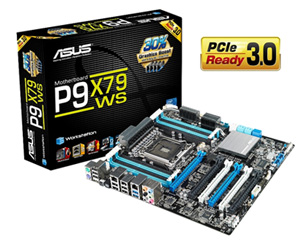
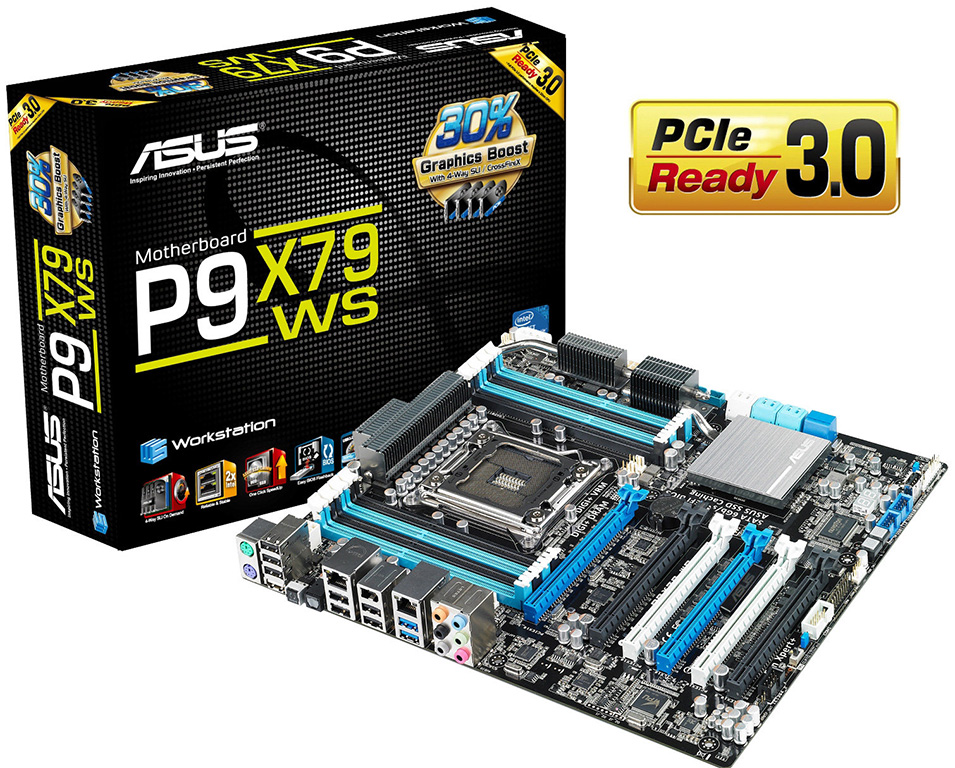
Based on the ATX form-factor, the P9X79WS uses a typical X79 motherboard layout. The socket LGA2011 is powered by a 10-phase Digi+ VRM, which is cooled by a heatsink that shares its heat with a VRM heatsink cluster over the memory VRM, and the one over the X79 PCH. There are eight DDR3 DIMM slots, supporting quad-channel DDR3 memory. All expansion slots are PCI-Express long-type, though the exact lane configuration is not known. The board is advertised with 4-way NVIDIA SLI and CrossFireX support, so at least four of those slots could be wired to the CPU.
Storage connectivity includes two SATA 6 Gb/s and four SATA 3 Gb/s from the PCH, two SATA 6 Gb/s from a discrete controller, and surprisingly, no eSATA. ASUS could have taken the opportunity to provide a more robust storage connectivity, maybe even drop in a discrete SAS controller. There are six USB 3.0 ports, two on the rear panel, four by headers. There are two gigabit Ethernet connections, both driven by Intel-made controllers. Firewire and 8-channel HD audio make for the rest of it. Expect this one to be among the more expensive socket LGA2011 motherboards you can buy from ASUS.
Source: SweClockers
Based on the ATX form-factor, the P9X79WS uses a typical X79 motherboard layout. The socket LGA2011 is powered by a 10-phase Digi+ VRM, which is cooled by a heatsink that shares its heat with a VRM heatsink cluster over the memory VRM, and the one over the X79 PCH. There are eight DDR3 DIMM slots, supporting quad-channel DDR3 memory. All expansion slots are PCI-Express long-type, though the exact lane configuration is not known. The board is advertised with 4-way NVIDIA SLI and CrossFireX support, so at least four of those slots could be wired to the CPU.
Storage connectivity includes two SATA 6 Gb/s and four SATA 3 Gb/s from the PCH, two SATA 6 Gb/s from a discrete controller, and surprisingly, no eSATA. ASUS could have taken the opportunity to provide a more robust storage connectivity, maybe even drop in a discrete SAS controller. There are six USB 3.0 ports, two on the rear panel, four by headers. There are two gigabit Ethernet connections, both driven by Intel-made controllers. Firewire and 8-channel HD audio make for the rest of it. Expect this one to be among the more expensive socket LGA2011 motherboards you can buy from ASUS.
Source: SweClockers
Friday, November 4, 2011
ASUS Bundles Battlefield 3 with Graphics Cards and Sound Cards
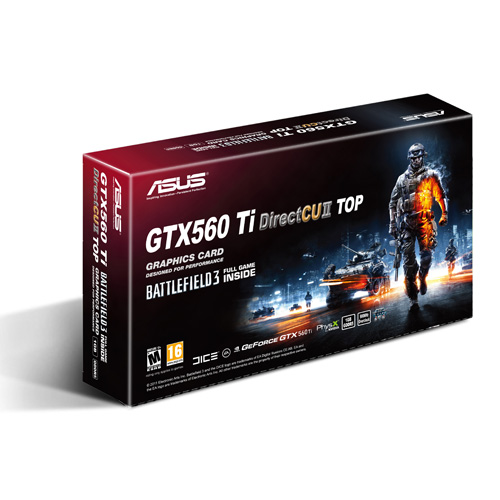
ASUS began bundling copies of Battlefield 3 (not Limited Edition) and an
ASUS-Battlefield 3 themed Lanyard with GeForce GTX 560 Ti DirectCU II
TOP graphics card and Xonar D2X PCI-Express 7.1 channel sound card. You
can buy either of those and get a Battlefield 3 coupon that can be
redeemed on Origin.
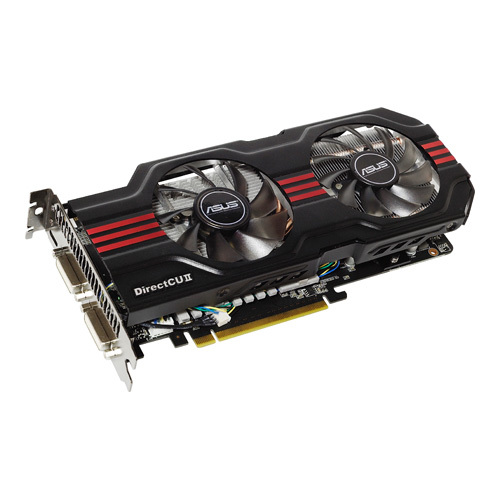
The GeForce GTX 560 Ti TOP will allow you to play Battlefield 3 at 1080p resolution with quite some eye-candy turned on. Its core is overclocked to 900 MHz (from NVIDIA reference speed of 820 MHz), and memory at 1050 MHz (4200 MHz GDDR5 effective). The DirectCU II cooler, ASUS claims, keeps the card 20% cooler than the reference heatsink. There is 1 GB of GDDR5 memory across a 256-bit wide memory interface. This GTX 560 Ti is based on the 40 nm GF114 silicon, packing 384 CUDA cores.
Next up is the Xonar D2X sound card, which is based on ASUS AV200 audio processor (C-Media CMI8788 OxygenHD derivative), with four TI Burr-Brown PCM1796 output DACs (total of 8 channels), and Cirrus-Logic CS5381 mic/line input ADC. The card can provide an output signal-noise ratio of 118 dBA. It supports all PCM output resolutions, including 24-bit 192 KHz. The card seats on any PCI-Express slot. This card, ASUS claims, will let you squeeze the most out of the already perfect Battlefield 3 sound design, helping you hear your enemies better.
Source: ASUS
The GeForce GTX 560 Ti TOP will allow you to play Battlefield 3 at 1080p resolution with quite some eye-candy turned on. Its core is overclocked to 900 MHz (from NVIDIA reference speed of 820 MHz), and memory at 1050 MHz (4200 MHz GDDR5 effective). The DirectCU II cooler, ASUS claims, keeps the card 20% cooler than the reference heatsink. There is 1 GB of GDDR5 memory across a 256-bit wide memory interface. This GTX 560 Ti is based on the 40 nm GF114 silicon, packing 384 CUDA cores.
Next up is the Xonar D2X sound card, which is based on ASUS AV200 audio processor (C-Media CMI8788 OxygenHD derivative), with four TI Burr-Brown PCM1796 output DACs (total of 8 channels), and Cirrus-Logic CS5381 mic/line input ADC. The card can provide an output signal-noise ratio of 118 dBA. It supports all PCM output resolutions, including 24-bit 192 KHz. The card seats on any PCI-Express slot. This card, ASUS claims, will let you squeeze the most out of the already perfect Battlefield 3 sound design, helping you hear your enemies better.
Source: ASUS
Subscribe to:
Posts (Atom)